Study · Kresmion Research
More Than Half of AST SpaceMobile's Last Reported Revenue Was a Sale to a Company It Half Owns. Three Other Things in the Filings.
Published by Kresmion Research. Read our editorial approach and data methodology.
By Kresmion Research, June 29, 2026
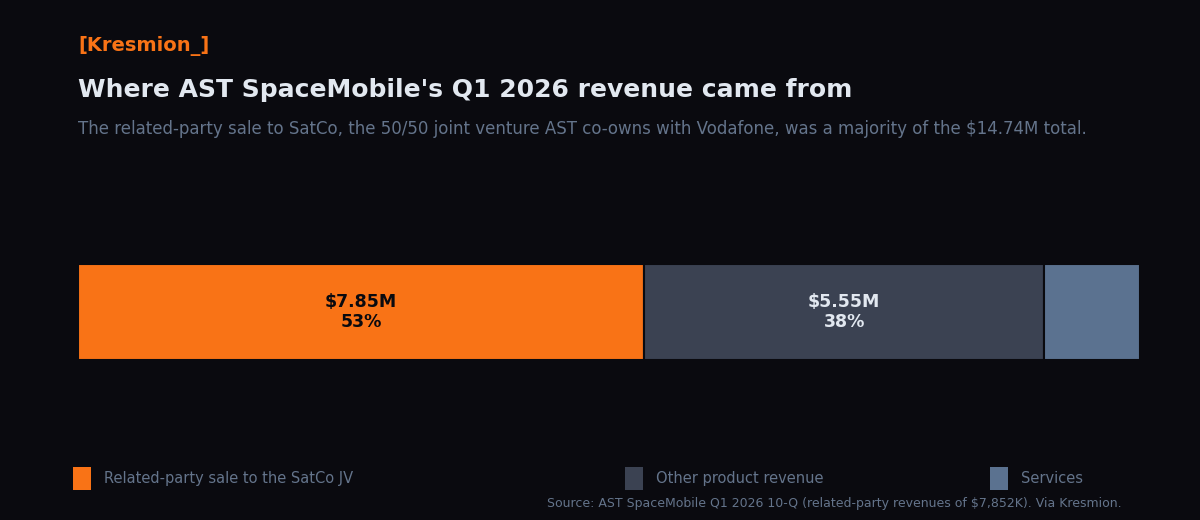
In AST SpaceMobile's most recent quarterly filing, $7.852 million of the company's $14.735 million in revenue came from a sale to a joint venture it half owns. That is 53 percent of total Q1-2026 revenue, and it was not a figure widely discussed in the coverage following the earnings release. Three other disclosures in the same filing deserve the same close read.
This piece is a forensic walkthrough of AST SpaceMobile's public SEC filings. It is not advice, not a forecast, and not a position recommendation. For every fact that reads as a concern, there is a reasonable counter-argument, and this piece gives both.
Key takeaways
| Measure | Reading | Source |
|---|---|---|
| Q1-2026 related-party revenue | $7.852M of $14.735M total (53%) was a sale to SatCo, a 50/50 joint venture with Vodafone | ASTS Q1-2026 10-Q |
| Founder voting power | Abel Avellan holds about 75% of votes via non-economic Class C shares; contractual ceiling is 88.31% | ASTS 13D/A, June 2025 |
| Ligado spectrum payments | $520M paid as capital advances; $100M frozen in bankruptcy court escrow; at least $80M annual obligation off-balance sheet | ASTS Q1-2026 10-Q |
| Potential dilution | 127.9M shares excluded from diluted EPS as anti-dilutive, about 42.8% of current Class A count | ASTS Q1-2026 10-Q |
| Full-year 2026 guidance | $150-200M, with about half from contracted backlog | ASTS Q1-2026 earnings release |
More than half of last quarter's revenue was a sale to a company it half owns
AST SpaceMobile's income statement for Q1-2026 shows total revenue of $14.735 million: $13.406 million in products and $1.329 million in services. In a footnote to the products line, the company discloses that $7.852 million of those product revenues came from a related party. That party is SatCo, a 50/50 joint venture between AST and Vodafone, headquartered in Luxembourg, set up to operate the European direct-to-phone service. In Q1-2025, that figure was $0.
The accounting mechanics matter here. SatCo is accounted for under the equity method. AST is not the primary beneficiary of this unconsolidated variable-interest entity, so SatCo's financials do not roll into AST's consolidated statements. Because SatCo is not consolidated, the $7.852 million sale is NOT eliminated. It stays in reported revenue. What IS adjusted is the intra-entity profit: the gain AST earned on the sale flows through as a larger loss in the equity-in-net-losses-of-investees line, which effectively defers that profit. So the headline revenue figure reflects a real transaction, but one between AST and a venture it half controls.
Two things follow. First, external revenue for the quarter was about $6.9 million. Second, because the unit of analysis for top-line growth is consolidated revenue, another quarter of gateway sales to SatCo could move that number materially without any new arm's-length customer.
The counter-argument: SatCo is genuinely building European service. The gateway equipment was real product, delivered to a real entity undertaking a real build. The profit on the sale does not inflate the income statement. Product revenue is lumpy by nature, and one quarter is a thin slice. The open question is whether external demand, not JV demand, sustains the trajectory.
Shareholders own the economics. The founder owns the vote.
Abel Avellan holds 78,163,078 Class C shares. The filing describes them as "non-economic." They carry voting power, specifically the lesser of ten votes per share or a formula amount, but they have essentially no claim on the company's assets or earnings. Public Class A shareholders hold most of the economic interest. Per the June 2025 Schedule 13D/A, Avellan holds about 75 percent of total voting power against an economic interest of roughly 24 percent. The 88.31 percent figure that appears in the 10-Q is a contractual ceiling, the maximum that the formula-capped vote can reach, not his current actual power.
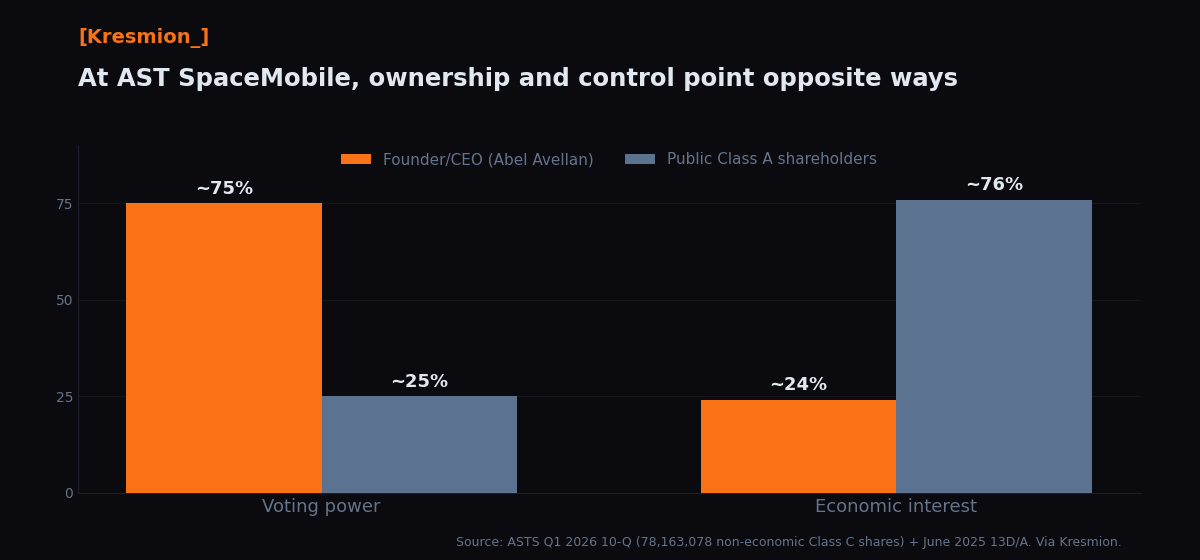
The practical consequence: Avellan can effectively determine the outcome of most shareholder votes, from capital allocation to executive changes to the response to a potential acquirer. Public Class A shareholders have limited formal ability to override that control. They own the cash flows. They do not own the direction.
The counter-argument: founder supervoting is common among founder-led companies managing long-dated, capital-intensive builds. The structure keeps the company from being deflected by quarterly pressure at exactly the moment when a multi-year satellite build requires long-horizon commitment. Supporters would say the concentration of control is a deliberate design choice, not an oversight.
A spectrum bill the balance sheet does not show
Low-band spectrum for direct-to-phone satellite service is strategically scarce. AST agreed to pay $550.0 million for access to Ligado's L-band spectrum in North America. It has paid $420.0 million on October 31, 2025, and a further $100.0 million around March 31, 2026, bringing total payments to $520.0 million, recorded as capital advances in Other non-current assets.
That second payment of $100.0 million is currently frozen in escrow by order of the U.S. Bankruptcy Court for the District of Delaware, dated April 2, 2026. Ligado is in bankruptcy. The release of those funds is subject to further court order.
AST does not yet control this spectrum. Closing is conditional on receiving all required regulatory and FCC approvals, which remain pending.
Beyond the purchase cost, AST owes an ongoing access payment of at least $80.0 million per year for the L-band spectrum, plus a separate smaller annual payment to Crown Castle. The filing classifies these as off-balance-sheet commitments and states explicitly that those obligations "were not recognized in the consolidated financial statements" as of March 31, 2026. That means neither this year's obligation nor future obligations appear as liabilities on the balance sheet you are reading.
The counter-argument: the $550.0 million payment is funded through a non-recourse credit facility held in a subsidiary called SpectrumCo. Non-recourse means the parent is not directly liable if the facility defaults, which caps the parent's direct exposure. And L-band spectrum is a real strategic asset that some competitors lack for low-orbit direct-to-phone service, particularly for deeper indoor penetration. If the FCC approvals come through, what is currently $520.0 million in capital advances becomes a controlled spectrum license.
The model is build now, dilute as you go
As of March 31, 2026, AST had 298,454,029 Class A shares outstanding. Another 127,856,531 shares are potentially dilutive but were excluded from the diluted loss-per-share calculation because the company is loss-making and including them would reduce the reported loss per share. That 127.9 million shares is about 42.8 percent of the current Class A count.
Those excluded shares break down as: 78,163,078 Class C (Avellan's non-economic voting shares), 11,215,111 Class B, 12,653,522 equity awards, and 25,824,820 shares representing conversion of outstanding convertible notes. Total debt principal is $3,024.1 million, most of it convertible notes across four series. Conversion prices range from roughly $27 to roughly $116 depending on the series; the two largest 2036 series convert at roughly $96 and roughly $116, with maturities in 2032 and 2036.
On the build side: on April 19, 2026, the Block 2 BB7 satellite went to a lower-than-planned orbit on the New Glenn 3 mission and was lost. The company expects an asset write-off of $155.0 million to $160.0 million. That is a reminder that satellite builds carry execution risk that no financing structure eliminates.
The counter-argument: the company held approximately $3.46 billion in cash and equivalents as of March 31, 2026 (roughly $3.03 billion unrestricted). That cash position covers a meaningful stretch of the build before the next raise. The convertible notes carry conversion prices well above where earlier dilution occurred, and there is no near-term maturity wall given the 2032 and 2036 maturities. Issuing equity and convertible debt to fund capital-intensive infrastructure ahead of revenue scale is a standard approach for this type of company. Whether this particular network reaches the subscriber scale that justifies the capital stack is the actual question.
How to read a story stock's filings
The ASTS filing is a worked example of four checks worth running on any pre-profit company with a large market value and a headline revenue number.
Check the related-party lines in the revenue note. Most income statements carry a footnote disclosing how much of product or service revenue came from related parties. A company selling to a venture it partly controls is not the same as selling to an arm's-length customer. The question is not whether the revenue "counts," but whether you are modeling external demand or internal demand. These are different growth profiles.
Check the share class and voting structure. The Class C share structure here is visible in the 10-Q's equity section and in Schedule 13D/A filings on EDGAR. A share class labeled "non-economic" that carries ten votes per share is a material governance fact. Who controls the vote controls the company, regardless of who owns the cash flows. In any founder-controlled company, knowing this gap is the first thing, not the last.
Check the off-balance-sheet commitments note. Balance sheets do not show every obligation. The ASTS 10-Q has an explicit note stating that the annual spectrum access payments were not recognized in the consolidated financial statements. Lease commitments, take-or-pay contracts, spectrum access fees, and licensed-spectrum obligations commonly live in this note, not on the liability side of the balance sheet. Reading the balance sheet without reading the commitments note gives an incomplete picture of the company's total obligation stack.
Check the diluted share count and the anti-dilutive exclusions. When a company is loss-making, GAAP requires excluding potentially dilutive shares from the diluted EPS calculation. The share count in the headlines is not the count an investor would face if the company turned profitable and all conversion rights, warrants, and equity awards were exercised. The reconciliation table in the earnings-per-share note shows what was excluded and why. The number can be large relative to shares already outstanding.
How to think about the value, without a recommendation
The skeptical read and the constructive read of ASTS start from the same filings and disagree on one underlying question: is the dilution funding a real network that will eventually carry hundreds of millions of phones through AT&T, Verizon, and global carriers, or is it funding a capital story that keeps needing fresh rounds to sustain itself?
The constructive case points to signed carrier agreements, including AT&T and a $45.0 million commercial prepayment from Verizon, plus arrangements with STC, Rakuten Mobile, and Vodafone. Full-year 2026 revenue guidance is $150.0 to $200.0 million, with about half from contracted backlog. Proponents would say the market value reflects the option value of reaching that addressable market, not the current revenue run rate.
The skeptical case points to a $3,024.1 million debt load on a company generating single-digit millions in quarterly external revenue, a governance structure that gives public shareholders limited formal recourse, a spectrum asset that is not yet legally controlled and sits in a bankruptcy proceeding, a lost satellite generating a write-off comparable to a full year of guidance revenue, and a balance sheet that omits material annual obligations.
The things that would shift the argument are observable: whether the FCC issues the Ligado spectrum approvals, whether non-JV revenue grows materially through the rest of 2026, and whether the remaining satellite build continues on plan. Those are the disclosures to watch in the next two or three quarters. No current fact settles the disagreement; they just define what the disagreement is about.
Frequently asked questions
Did AST SpaceMobile really sell most of its revenue to itself?
Not exactly. The $7.852 million was a sale to SatCo, a 50/50 joint venture with Vodafone, not to AST's own consolidated subsidiary. Because SatCo is accounted for under the equity method and is not consolidated into AST's financials, the sale appears in reported revenue rather than being eliminated in consolidation. The profit on the sale is deferred through the equity-method investment loss line, so AST does not double-count the economics. But it does mean the headline revenue figure includes a transaction with a venture AST half controls, which is a different thing from selling to an unrelated carrier.
Is the founder's control unusual?
The structure itself is not unusual. Many founder-led technology and infrastructure companies use supervoting shares to give the founder disproportionate control during a long-dated build phase. What the ASTS filing makes specific is the magnitude: roughly 24 percent of the economics against roughly 75 percent of the votes, with a contractual ceiling at 88.31 percent. Investors in founder-controlled companies can point to examples where the concentrated control worked in their favor over a long horizon. The risk is that when it does not, there is no formal mechanism to change direction.
What is the Ligado spectrum payment?
Ligado is a company that holds L-band spectrum licenses in North America, which is spectrum useful for direct-to-phone satellite service. AST agreed to pay $550.0 million for access to that spectrum and has paid $520.0 million to date. The most recent $100.0 million is currently frozen in escrow while Ligado goes through bankruptcy proceedings in the U.S. Bankruptcy Court for the District of Delaware. The deal is not closed: AST will not control the spectrum until it receives all required FCC and regulatory approvals, which are still pending. There is also an ongoing annual access payment of at least $80.0 million that does not appear as a liability on the balance sheet.
Is the dilution a problem?
That depends on what the capital funds. As of March 31, 2026, roughly 127.9 million potentially dilutive shares were excluded from the diluted EPS count, about 42.8 percent of the current Class A share count. If the company reaches the subscriber and revenue scale that the carrier agreements suggest is possible, dilution at the scale of a satellite network build would look ordinary in retrospect. If it does not reach that scale, each capital raise will have been progressively harder to justify. The company held roughly $3.46 billion in cash and equivalents as of March 31, 2026. The capital position buys time. It does not guarantee the outcome.
Sources
- Kresmion compiled this study from AST SpaceMobile's public SEC filings, as of June 29, 2026.
- AST SpaceMobile Q1-2026 Form 10-Q (SEC, period ended March 31, 2026, filed May 11, 2026): https://www.sec.gov/Archives/edgar/data/1780312/000119312526216950/asts-20260331.htm
- AST SpaceMobile Q1-2026 earnings release (8-K, May 11, 2026): https://www.businesswire.com/news/home/20260511685431/en/
- AST SpaceMobile Schedule 13D/A (June 2025), voting power: https://www.stocktitan.net/sec-filings/ASTS/schedule-13d-a-ast-space-mobile-inc-sec-filing-004915d7521a.html
- · Kresmion compiled this study from AST SpaceMobile's public SEC filings, as of June 29, 2026.
- · AST SpaceMobile Q1-2026 Form 10-Q (SEC, period ended March 31, 2026, filed May 11, 2026). https://www.sec.gov/Archives/edgar/data/1780312/000119312526216950/asts-20260331.htm
- · AST SpaceMobile Q1-2026 earnings release (8-K, May 11, 2026). https://www.businesswire.com/news/home/20260511685431/en/
- · AST SpaceMobile Schedule 13D/A (June 2025), voting power. https://www.stocktitan.net/sec-filings/ASTS/schedule-13d-a-ast-space-mobile-inc-sec-filing-004915d7521a.html
Filter the whole equity universe on institutional, insider, congressional and options fields at once.
Free to view, no account needed.
Put this to work
Real filings, 13F flows, and positioning reads with the source on every number, in your inbox when there is something in the data, or live on Telegram. Free, no account.
No fixed schedule: it goes out when the data has something in it. Unsubscribe anytime.
Kresmion publishes information, not investment advice. See our methodology and the latest research notes.