Study · Kresmion Research
Private Credit's Gates Came Down in June. We Checked Which Numbers Held Up.
Published by Kresmion Research. Read our editorial approach and data methodology.
By Kresmion Research, June 23, 2026
In the middle of June 2026, Kresmion's intelligence feed lit up with a cluster of private credit items that all pointed the same way: redemption requests surging, funds adding restrictive language, money supposedly fleeing illiquid credit for the liquid kind. It looked like a clean rotation story. So we did the thing the feed itself cannot do, which is check every number against a primary source before writing it down. Two of the loudest figures did not survive that check. What did survive is a real and more careful story about the plumbing of private credit being tested.
This is a description of verified events and what the data does and does not support, not a recommendation and not a forecast.
Key takeaways
| Measure | Reading | Source |
|---|---|---|
| Blackstone BCRED redemption requests | Hit 10 percent of shares in Q2, up from 7.9 percent in Q1, met only up to the 5 percent quarterly gate, its first ever cap | Bloomberg and CNBC (external) |
| Apollo Debt Solutions requests | Withdrawal requests near 16.8 percent of shares, also held to a 5 percent gate | CNBC (external) |
| The two numbers that failed verification | A market wide 12 billion dollar, up 56 percent redemption figure, and a 3.5 billion dollar leveraged loan fund inflow streak | Unsourced and, for the inflows, contradicted by the data |
| Scale | Private credit is roughly a 1.7 to 2 trillion dollar market | Mordor Intelligence and Moody's (external) |
What the feed flagged, and what we cut
Kresmion's intelligence feed aggregates headlines into clusters. In mid June it surfaced six private credit items, none of which carried a primary source link, which is exactly why each had to be checked rather than repeated. Two of them anchored the original rotation narrative, and both failed.
The first was a claim that private credit fund withdrawals had surged 56 percent to 12 billion dollars in the quarter. We could find no reputable source for that aggregate, that percentage, or the prior quarter base it implied. A single market wide dollar figure with no auditable provider is precisely the kind of number that should not anchor a study, so we cut it.
The second was a claim that US leveraged loan funds had pulled in 3.5 billion dollars over ten consecutive weeks, the supposed destination of the fleeing money. This one is not merely unsourced, it points the wrong way. The public record shows US leveraged loan funds in outflow for much of 2026, including about 3.4 billion dollars of withdrawals in a single month earlier in the year as investors shed credit risk (Reuters via Investing.com). The clean idea that money rotated out of illiquid credit and into liquid loan funds is not supported. If anything, investors were de risking credit broadly.
So the title and the thesis had to change. What remains, and what is solidly sourced, is the gating cascade itself.
The gating cascade that did hold up
The verifiable core is that the largest semi liquid private credit funds hit their redemption limits at once.
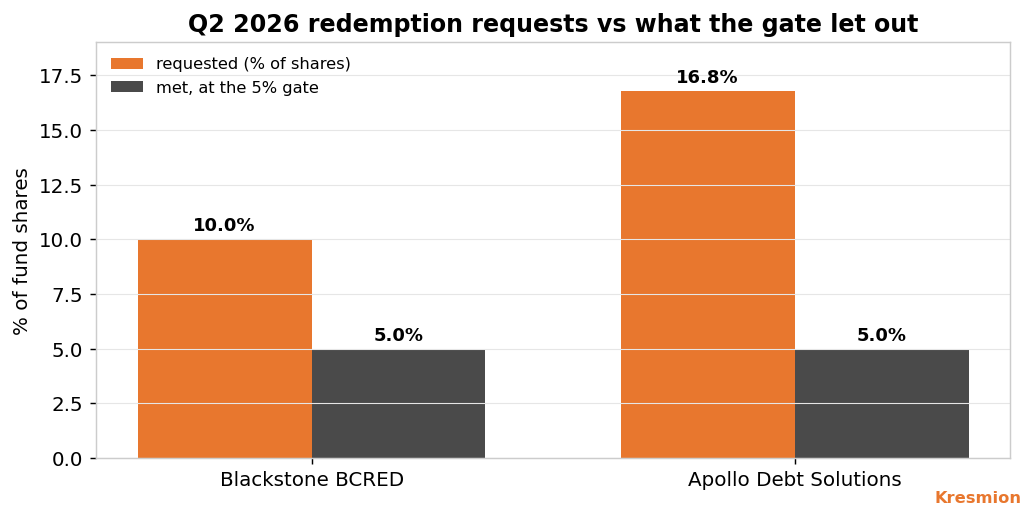
Blackstone's roughly 79 billion dollar private credit fund, BCRED, saw redemption requests reach about 10 percent of shares in the second quarter, up from 7.9 percent in the first, and for the first time ever the manager could only fulfill them up to the structural 5 percent quarterly gate (Bloomberg). Around the same window, Apollo's Debt Solutions fund saw withdrawal requests spike toward 16.8 percent of shares and was likewise capped near the 5 percent limit (CNBC). These are real liquidity gating events at two of the biggest names in the space, and they are the honest spine of the story.
Why the gate is the whole point
This is where the careful framing matters, because the gate changes what the numbers mean. A redemption request is a demand to exit. It is not the same as money actually leaving. When BCRED received requests for 10 percent of shares but paid out only 5 percent, the gate did exactly what it was designed to do: it slowed realized outflows to half of what was asked. A headline that reads withdrawals surge describes the demand to leave, while the structure quietly limits the actual departure. Both facts are true, and only the pair of them together is honest.
The mechanism behind the rotation idea is real even though the flow numbers were not. Broadly syndicated leveraged loans and private credit are increasingly interconnected corners of the same corporate lending market, but one tier trades daily and is marked to market, while the other is held by a small club of lenders, is only partially liquid, and is marked far less often (Global Legal Insights). When investors want liquidity back, the gated, stale marked tier is the one where the exit door is narrow. That is why the stress shows up as gates rather than as a clean price move.
Scale and the counter case
The strongest argument against reading this as a crisis is scale and design. Private credit is a roughly 1.7 to 2 trillion dollar market (Mordor Intelligence, Moody's). Even the unverifiable 12 billion dollar figure, had it been real, would have been well under one percent of that market. The redemption pressure is better read as a percentage of each fund's own assets, where single digit to mid teens percentages of net asset value are meaningful but not extraordinary, than as a fragile market wide dollar total.
And the gates themselves are not evidence of failure. They are the shock absorber these funds were built with. A 5 percent quarterly limit exists precisely so that a wave of requests cannot force a fire sale of assets that take months to value. The cascade shows the absorber being used, which is a different thing from the absorber breaking. We also did not confirm that any single filing newly added restrictive language this quarter, as one feed item implied; gate language is standard boilerplate for semi liquid funds, so we make no novelty claim there.
What to watch
The observable tell is not the request totals, which gating distorts, but whether the gates stay full. If requests keep arriving at the 5 percent ceiling for a second and third consecutive quarter, the backlog of unmet redemptions builds and the pressure compounds. If requests fall back below the gate, the wave was a one quarter scare absorbed by design. The second tell is marks: gated, stale marked assets eventually have to be revalued, and the gap between where these funds carry assets and where the liquid loan market prices the same borrowers is the thing to keep an eye on.
For the companion view of how a tracked slice of institutional money is positioned in private credit's public proxies, see our earlier study, Private Credit's Public Shadow.
Frequently asked questions
Did 12 billion dollars really leave private credit?
We could not verify that figure, so we did not publish it as fact. There is no auditable source for a market wide 12 billion dollar, up 56 percent redemption number. What is verifiable is that specific large funds, including Blackstone's BCRED and Apollo's Debt Solutions, hit their redemption gates in the second quarter of 2026.
Does a redemption gate mean a fund is in trouble?
Not by itself. A gate is a designed limit, usually 5 percent of shares per quarter, that exists so a fund does not have to offload hard to value assets quickly. When a gate binds, it shows demand to exit exceeded the limit, but it also means the fund slowed actual outflows rather than dumping assets. It is a shock absorber being used.
Did money rotate into leveraged loan funds?
The data does not support that. US leveraged loan funds were in outflow for much of 2026, so the claim that money fled private credit for those funds specifically failed verification. Investors appear to have de risked credit broadly rather than rotating cleanly from one tier to another.
How is this different from your earlier private credit study?
The earlier piece, Private Credit's Public Shadow, looked at how the institutions Kresmion tracks are positioned in private credit's public proxies through 13F filings. This piece is about a specific June 2026 liquidity event, the redemption gating at major funds, and which of the surrounding numbers held up to checking.
Sources
External, each verified to a working report: Bloomberg on Blackstone BCRED limiting redemptions; CNBC on Apollo Debt Solutions withdrawals; Reuters via Investing.com on leveraged loan fund outflows; Mordor Intelligence private credit market size; Moody's 2026 private credit outlook; Global Legal Insights comparison of broadly syndicated loans and private credit.
Kresmion internal: the intelligence feed cluster that surfaced these items (intelligence_events, mid June 2026), used here as the starting point for verification rather than as a source of figures. Related Kresmion reading: Private Credit's Public Shadow and the Research Notes archive.
- · Bloomberg on Blackstone BCRED limiting redemptions, https://www.bloomberg.com/news/articles/2026-06-04/blackstone-bcred-joins-private-credit-funds-limiting-redemptions
- · CNBC on Apollo Debt Solutions withdrawals, https://www.cnbc.com/2026/06/23/apollo-private-credit-fund-withdrawals-redemptions.html
- · Reuters via Investing.com on leveraged loan fund outflows, https://www.investing.com/news/stock-market-news/outflows-from-leveraged-loan-funds-jump-as-investors-shun-credit-risk-4608195
- · Mordor Intelligence private credit market size, https://www.mordorintelligence.com/industry-reports/private-credit-market
- · Moody's 2026 private credit outlook, https://www.moodys.com/web/en/us/insights/credit-risk/outlooks/private-credit-2026.html
- · Global Legal Insights comparison of broadly syndicated loans and private credit, https://www.globallegalinsights.com/practice-areas/private-credit-laws-and-regulations/overview-and-comparison-of-the-broadly-syndicated-loan-and-private-credit-markets/
- · Kresmion intelligence_events private credit cluster, mid June 2026 (verification starting point)
Filter the whole equity universe on institutional, insider, congressional and options fields at once.
Free to view, no account needed.
Put this to work
Real filings, 13F flows, and positioning reads with the source on every number, in your inbox when there is something in the data, or live on Telegram. Free, no account.
No fixed schedule: it goes out when the data has something in it. Unsubscribe anytime.
Kresmion publishes information, not investment advice. See our methodology and the latest research notes.