Explainer · Kresmion Research
What Is a Cross-Asset Market Regime Score?
Published by Kresmion Research. Read our editorial approach and data methodology.
See it liveLive central bank policy rates →Free, no account needed.
A cross-asset market regime score is one standardized daily number that folds dozens of macro and market signals into a single risk-on or risk-off reading.
Instead of tracking equities, credit, rates, the dollar, volatility, and commodities one indicator at a time, the regime score combines them into one comparable number and a plain-English label. The result is a single reading that summarizes what fifteen separate market and economic signals are saying at the same moment, so you can see at a glance what kind of environment the data describes.
Key takeaways
| Metric (as stored for June 15, 2026) | Value |
|---|---|
| Smoothed regime score | 0.2208 |
| Raw regime score | 0.2743 |
| Regime label | Risk-On (current banding, applied to the stored history on July 28, 2026; the engine published Neutral that day) |
| Conviction | 100.00% (HIGH) |
| Regime age | 1 day in the re-banded history (47 days as published that day) |
| Highest positive factor | Volatility, +0.7464 |
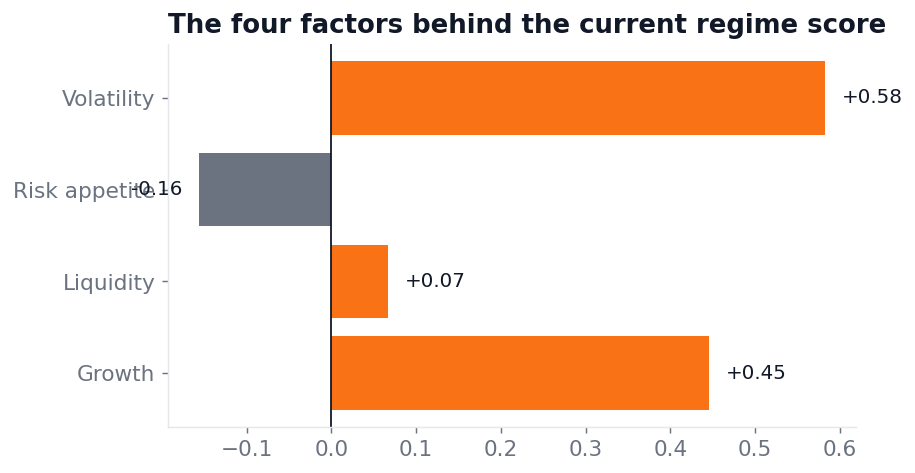
As stored for June 15, 2026, the Kresmion Macro Regime dataset shows a smoothed regime score of 0.2208, a raw score of 0.2743, and a Risk-On label at HIGH conviction of 100.00%. That label comes from the current banding, which Kresmion applied to every earlier stored row on July 28, 2026, when it began scaling the score before banding it; on the day itself the engine, under its older bands, published Neutral, a label it had then held for 47 days.
What goes into the score
The score fuses a basket of cross-asset and macro signals rather than leaning on any one indicator. Per Kresmion's methodology page, the inputs are fifteen: the 10-year minus 2-year Treasury spread, an economic surprise index, ISM manufacturing and services PMI, initial jobless claims, the distance of 10-year breakeven inflation from 2.25 percent, the 10-year real yield, the dollar index (DXY), the high-yield credit spread, the Chicago Fed financial conditions index (NFCI), net Fed liquidity (the Fed's balance sheet net of the overnight reverse repo facility and the Treasury's cash account), S&P 500 momentum, AUD/JPY, the copper to gold ratio, VIX, and MOVE.
Each input arrives on its own scale, so before anything is combined it is standardized. For most inputs the engine takes the change over the last five observations (five trading days for daily series, five weekly prints for jobless claims, NFCI and net liquidity) and expresses it as a z-score against that input's own history of such changes; the economic surprise index and S&P 500 momentum, which already measure change, are z-scored directly, and PMI is scored on its month-over-month change. Z-scoring means each signal's recent move is measured in standard deviations from its own typical move, which makes a credit spread and a volatility index directly comparable. Each z-score is clipped at plus or minus 3, so a single runaway reading cannot dominate. The factors are then weighted 20 percent Growth, 40 percent Liquidity, 30 percent Risk Appetite and 10 percent Volatility.
The four factors
Inside the Kresmion Macro Regime dataset, the standardized inputs roll up into four headline factors stored every day: Growth, Liquidity, Risk Appetite, and Volatility, each a numeric value. As stored for June 15, 2026, those sub-scores were Growth +0.1595, Liquidity +0.2952, Risk Appetite +0.1657, and Volatility +0.7464.
- Growth tracks real-economy momentum. It averages five inputs, dropping any that are missing or stale: the yield curve, the economic surprise index, PMI, initial jobless claims (sign inverted), and the distance of breakeven inflation from 2.25 percent (sign inverted). As stored for June 15, 2026, the yield-curve component was -0.2552, jobless claims +0.0475 and breakeven distance -0.7811 (inverted, it adds about +0.78); the surprise index (stored as 0.0) and PMI had no reading that day and were left out, so Growth averaged the other three.
- Liquidity captures financial conditions and money availability. It averages five inputs: the real yield, the dollar (DXY), the high-yield spread, and NFCI, all sign inverted, plus net Fed liquidity. As stored for June 15, 2026, its net-liquidity component was +0.4711, NFCI -0.1009, real yield -0.2712, DXY -0.3546, and the high-yield spread -0.2785.
- Risk Appetite measures cross-asset willingness to take risk via S&P 500 momentum, the high-yield spread (sign inverted, and also counted in Liquidity), the AUD/JPY pair, and the copper to gold ratio. As stored for June 15, 2026, the equity-momentum component was +0.1589, the high-yield spread -0.2785 and AUD/JPY +0.2254; the copper to gold ratio had no reading and, under the rule the engine used at the time, entered as zero (the engine now leaves a missing input out instead).
- Volatility captures the implied volatility regime through VIX and MOVE, both sign inverted, so falling volatility raises the factor. As stored for June 15, 2026, the VIX component was -0.6512 and MOVE -0.8417.
The four factors do not average out to the headline number. Their simple mean is about +0.342, while the raw score is 0.2743, because the raw score is a weighted sum: 0.20 × Growth + 0.40 × Liquidity + 0.30 × Risk Appetite + 0.10 × Volatility, which for June 15, 2026 is 0.0319 + 0.1181 + 0.0497 + 0.0746 = 0.2743. Liquidity carries the most weight, so a modest Liquidity reading moved the score more than the much larger Volatility reading did.
Reading the number: sign, buckets, and smoothing
A positive score reads risk-on, meaning a favorable cross-asset environment; a negative score reads risk-off. The scale is centered near zero and bounded by the clipping and standardization, not a 0-100 range. Across the 47 stored days from April 30 to June 15, 2026, the raw score ranged from -0.3497 to +0.4667 and the smoothed score from -0.3389 to +0.4168.
The smoothed score maps to one of five labels: Strong Risk-Off, Risk-Off, Neutral, Risk-On, and Strong Risk-On. The label is read straight off the smoothed score at fixed edges, with no hysteresis band: the score is multiplied by 3 and banded at plus or minus 0.5 and 1.5, which puts the edges at about plus or minus 0.17 and 0.5 on the score itself. The smoothing weights the day's raw reading at 70 percent, so a borderline label can change from one day to the next; Kresmion announces a regime change only after the new label has held for five stored daily readings.
Two numbers describe the same day. The raw composite is the same-day reading; the smoothed score is an exponentially smoothed version that damps the effect of a single outlier day. The lag is visible in the data: on June 13, 2026, the raw score was 0.1124 while the smoothed score was 0.0560, the smoothed value trailing the faster raw move.
Conviction and persistence
Two more fields round out the daily row. Conviction expresses how firmly the factors agree on the current label, stored as both a tier (LOW, MEDIUM, HIGH) and a percent. The percent is the share of the four factors that point the same way. In the observed window the tiers were MEDIUM at 50.00% on 10 days, HIGH at 75.00% on 26 days, and HIGH at 100.00% on 11 days. The `regime_age_days` field tracks how long the current label has held, and an `is_transition` flag marks the day a label changes. In the re-banded history June 15 has an age of 1 and the flag set, because the re-banded June 14 reads Neutral; as published on the day, the age was 47.
Each row also carries a plain-language interpretation, written by a language model over the row's numbers, that names the leading factor and its counterweights. The numbers, not the prose, are the record.
The engine recomputes about every six hours and again after major US data releases, per the methodology page, and each run rewrites that day's row, so the stored value for a day is its last run. In the re-banded history the 47 stored days read Neutral on 22, Risk-On on 14 and Risk-Off on 11 (as published at the time, all 47 read Neutral); neither Strong label appears in this sample (and with four factors the LOW conviction tier never does, since at least two always point the same way), and the score range above is a sample range, not a theoretical bound.
How to read it day to day
The score is built to be glanced at, not decoded. The label answers the broad question of whether the cross-asset backdrop is leaning risk-on, risk-off, or neutral; the conviction tier tells you how unified the underlying factors are behind that label; and the four factors show which forces are pulling and which are pushing back. As stored for June 15, 2026, that picture is a Risk-On reading in the re-banded history with HIGH conviction, all four factors positive and Volatility the largest, a snapshot of context rather than a signal to act on.
Frequently asked questions
What does the regime score measure?
It measures the combined state of many cross-asset and macro signals as a single standardized number. A positive value reads risk-on and a negative value reads risk-off, with the smoothed value mapped to one of five named labels.
What is the difference between the raw and smoothed score?
The raw score is the same-day composite, and the smoothed score is an exponentially smoothed version of it that damps the effect of one outlier day. On June 13, 2026, the raw score was 0.1124 versus a smoothed 0.0560, showing the smoothed value lagging the raw move.
What does conviction mean?
Conviction is how firmly the four factors agree on the current label, stored as a tier (LOW, MEDIUM, HIGH) and a percent. As stored for June 15, 2026, conviction was HIGH at 100.00%, with all four factors positive.
Why does the score sit near zero instead of 0 to 100?
Because each input is z-scored against its own recent history and clipped before being combined, the composite is centered near zero. Over the April 30 to June 15, 2026 window the smoothed score ranged from -0.3389 to +0.4168.
Correction, October 1, 2026: the scores and factors in the worked example are now the values stored for June 15, 2026, from that day's final run; an earlier version quoted an earlier run of the day (smoothed score 0.1179). Its Neutral label, held 47 days, was the label the engine published at the time; the stored labels, ages and transition flags before July 28, 2026 were recomputed that day under the current banding. The earlier version also placed several inputs in the wrong factors, said the label used hysteresis, and said the weights were not published.
---
Prepared by Kresmion Research. This page is information, not investment advice.
- · https://kresmion.com/about/methodology
- · Kresmion macro_regime_history, as stored for 2026-04-30 to 2026-06-15 (47 rows; June 15 row: label, scores, conviction, factors and z scores)
Every tracked central bank's policy rate, its latest change and the primary source behind it.
Free to view, no account needed.
Put this to work
Real filings, 13F flows, and positioning reads with the source on every number, in your inbox when there is something in the data, or live on Telegram. Free, no account.
No fixed schedule: it goes out when the data has something in it. Unsubscribe anytime.
Kresmion publishes information, not investment advice. See our methodology and the latest research notes.