Study · Kresmion Research
Warsh Inherited a 6.7 Trillion Dollar Balance Sheet. Here Is Where Its Liquidity Stance Shows Up in Our Regime Score.
Published by Kresmion Research. Read our editorial approach and data methodology.
By Kresmion Research, June 23, 2026
Kevin Warsh took over a Federal Reserve whose balance sheet still holds roughly 6.7 trillion dollars in assets, and the question every cross asset investor is really asking is not the headline size but whether that pile of assets is still draining liquidity out of markets or quietly adding it back. Kresmion does not carry the Fed balance sheet as a data series. What it does carry is a Liquidity factor inside its daily macro regime score, and that factor is the single most heavily weighted input in the whole model. This piece explains what that factor is, what it reads today, and how to line it up against the balance sheet story most headlines stop at.
This is an explanation of how one Kresmion input is built and what it shows, not a recommendation and not a forecast. Past readings of a factor need not repeat.
Key takeaways
| Measure | Reading | Source |
|---|---|---|
| Liquidity factor today | About minus 0.41, the most negative of the four regime factors and near the bottom of its own short history | Kresmion (macro_regime_history) |
| Its weight in the regime score | 40 percent, the largest of any factor | Kresmion regime methodology |
| Biggest drag inside it | The US dollar, at plus 1.58 standard deviations, inverted into a liquidity headwind | Kresmion (macro_regime_history z_scores) |
| Fed balance sheet size | About 6.74 trillion dollars, week ending June 17, 2026 | Federal Reserve H.4.1 (external) |
| Balance sheet runoff | Quantitative tightening formally ended December 1, 2025; the Fed has since run a reserve management regime | Federal Reserve and reporting (external) |
What the Liquidity factor is
Kresmion's macro regime score is a daily cross asset reading from minus 3 to plus 3, smoothed over five days, that sorts the world into Risk On, Neutral, or Risk Off. It is built from four factors. Liquidity carries 40 percent of the weight, more than Growth, Risk Appetite, or Volatility, because the price of money tends to lead everything else.
The Liquidity factor is the average of three inputs, each measured as a standardized z score against a rolling window and each sign inverted so that tighter conditions read as risk off: the real yield (the inflation adjusted ten year Treasury yield), the US dollar, and the high yield credit spread. When real yields rise, the dollar strengthens, or credit spreads widen, the factor falls. For a live example, Kresmion's July 13 note shows abundant liquidity contributing almost nothing to the risk score because the real cost of money has risen. It is, in plain terms, a gauge of how tight or loose financial conditions are, distilled into one number.
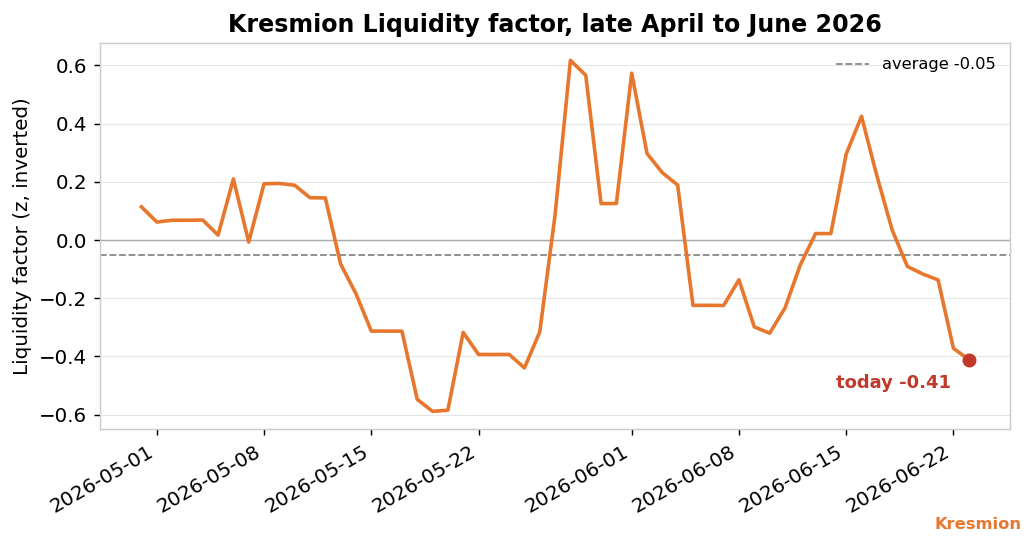
Today that number is about minus 0.41. Across the full history Kresmion has computed it, that is the fifth most negative reading and sits in the bottom tenth or so of its own range. The factor has slid almost without interruption since the middle of June, from about plus 0.42 on June 16 to minus 0.41 now.
Where the balance sheet sits today
Here is the part the Liquidity factor does not see directly, because Kresmion has no Fed balance sheet series in its database, so these figures are external and cited as such. The Federal Reserve's total assets stood near 6.74 trillion dollars in the week ending June 17, 2026, according to the Fed's own H.4.1 release (Federal Reserve H.4.1). That is down from a pandemic peak above 9 trillion dollars, but it is no longer falling.
The Fed formally ended quantitative tightening on December 1, 2025, with the balance sheet near 6.58 trillion dollars, and has since operated what it calls a reserve management regime, making modest purchases to keep bank reserves ample rather than letting assets run off (Federal Reserve, reporting). The roughly 160 billion dollar rise from 6.58 trillion to 6.74 trillion since then is consistent with that stance. In other words, on the central bank side, the direct drain on liquidity has stopped.
That is the puzzle worth sitting with. The Fed has stopped pulling liquidity out, yet Kresmion's Liquidity factor is near its floor. The factor is telling you that the tightening today is coming from somewhere other than the balance sheet.
What is dragging the factor right now
The factor decomposes cleanly. The largest drag by far is the US dollar, registering plus 1.58 standard deviations, which after the sign inversion becomes a liquidity headwind of about minus 1.58. The second drag is the real yield at plus 0.54 standard deviations, becoming about minus 0.54. Working the other way, the high yield credit spread is slightly tight, at minus 0.26 standard deviations, which after inversion adds a small positive of about plus 0.26. A related net liquidity input that Kresmion tracks is also mildly negative.
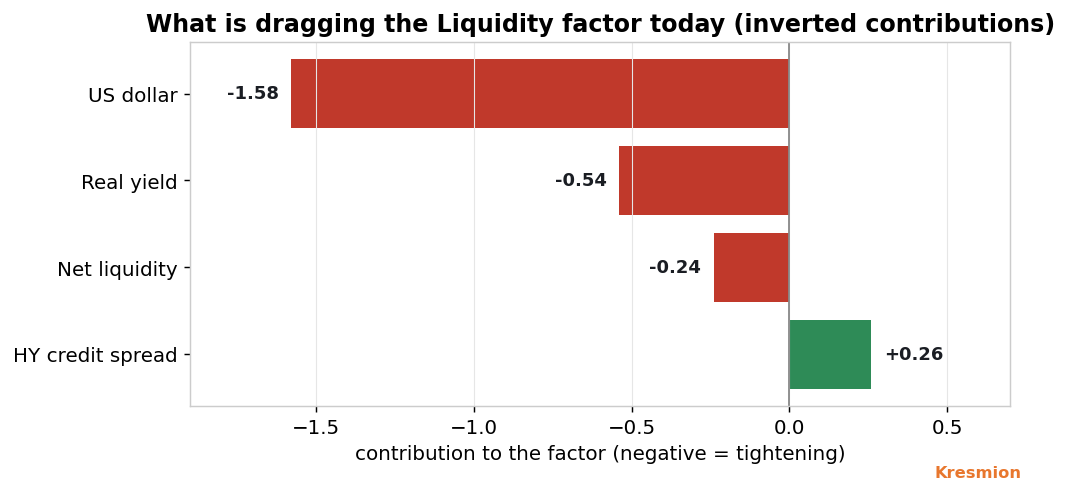
The message is specific. A strong dollar and high real yields are doing the tightening, while calm credit spreads are pushing the other way. This is market priced tightening, not central bank balance sheet tightening. It also lines up with the rest of the regime: with Liquidity at minus 0.41 carrying 40 percent of the weight, it is the single largest reason the overall score sits at about minus 0.23, a Neutral reading with high agreement among the factors.
What Warsh has signaled
Kevin Warsh was sworn in as Fed chair on May 22, 2026, and the June 17 meeting held the policy rate at 3.50 to 3.75 percent. On the balance sheet specifically, reporting and his confirmation testimony describe a chair who favors a smaller Fed footprint and less reliance on asset purchases as a policy tool, while stressing that any reduction must be slow, deliberate, and agreed by the full committee (Council on Foreign Relations, Invesco). We are deliberately not putting a direct quotation in his mouth here, because none could be verified to the word. The takeaway is directional: a Warsh Fed is more inclined to shrink the balance sheet over time than to grow it, which over a long horizon is a liquidity headwind layered on top of whatever the dollar and real yields are doing.
The honest limitations
Three caveats keep this honest. First, Kresmion has only computed this regime history since late April 2026, so when we say today is near the bottom of the factor's range, that range is a matter of weeks, not years. It is a real local extreme, not a multi year one. Second, the net liquidity input Kresmion tracks is a standardized signal, not the raw balance sheet level, so it should not be read as a direct proxy for the 6.74 trillion dollar figure. Third, the balance sheet numbers and the Warsh characterization are external, web sourced context, not Kresmion measurements, and are labeled that way throughout.
What to watch
The cleanest thing to watch is whether the dollar leg of the factor cools. Because the dollar is the dominant drag right now, a softer dollar would lift the Liquidity factor mechanically even if the Fed never touches the balance sheet. The opposite tell is the balance sheet itself: if a Warsh Fed signals a return to active runoff rather than reserve management, that would add a second, slower source of tightening underneath the market priced one the factor already captures. The factor is the place those two forces would meet.
Frequently asked questions
Does a negative Liquidity factor mean the Fed is draining money?
Not necessarily, and that is the point of this piece. The Fed ended its balance sheet runoff in December 2025 and has been holding reserves steady since. The factor is negative today mainly because the dollar is strong and real yields are high, which are market priced sources of tight conditions, not central bank balance sheet actions.
Why is the Liquidity factor weighted at 40 percent?
Because the cost and availability of money tends to lead the other cross asset factors. Kresmion gives it the largest weight of the four regime inputs for that reason. When liquidity tightens, growth, risk appetite, and volatility usually follow rather than lead.
Is the 6.7 trillion dollar balance sheet figure from Kresmion data?
No. Kresmion does not carry a Fed balance sheet series, so that number is external, taken from the Federal Reserve's H.4.1 release for the week ending June 17, 2026. The Kresmion contribution here is the Liquidity factor and its components, which are computed daily from market data.
How far back does the Liquidity factor history go?
Kresmion has computed this version of the regime score since late April 2026. So statements about today being near the bottom of the factor's range refer to a window of weeks. It is a genuine recent extreme, not a multi year low.
Sources
Kresmion internal data: macro_regime_history (Liquidity factor, component z scores for the dollar, real yield, and high yield spread, the overall regime score and conviction, all as of June 23, 2026). External: Federal Reserve H.4.1 balance sheet release; reporting on the end of quantitative tightening and the reserve management regime; Council on Foreign Relations on Kevin Warsh's early agenda; Invesco on the Warsh confirmation hearings.
Related Kresmion reading: What is a macro regime score and the Research Notes archive.
- · Kresmion macro_regime_history (Liquidity factor and component z scores for the dollar, real yield and high yield spread, regime score and conviction, June 23, 2026)
- · Federal Reserve H.4.1 balance sheet release, https://www.federalreserve.gov/releases/h41/current/
- · Reporting on the end of quantitative tightening, https://www.svb.com/market-insights/us-treasuries/the-federal-reserve-ends-qt-key-market-liquidity-insights/
- · Council on Foreign Relations on Kevin Warsh, https://www.cfr.org/articles/what-to-expect-from-kevin-warshs-fed-in-the-first-100-days
- · Invesco on the Warsh confirmation hearings, https://www.invesco.com/us/en/insights/three-takeaways-kevin-warsh-federal-reserve-chair-hearings.html
The current cross-asset risk regime score with the growth, liquidity, risk-appetite and volatility factors behind it.
Free to view, no account needed.
Put this to work
Real filings, 13F flows, and positioning reads with the source on every number, in your inbox when there is something in the data, or live on Telegram. Free, no account.
No fixed schedule: it goes out when the data has something in it. Unsubscribe anytime.
Kresmion publishes information, not investment advice. See our methodology and the latest research notes.