By Kresmion Research, October 14, 2026
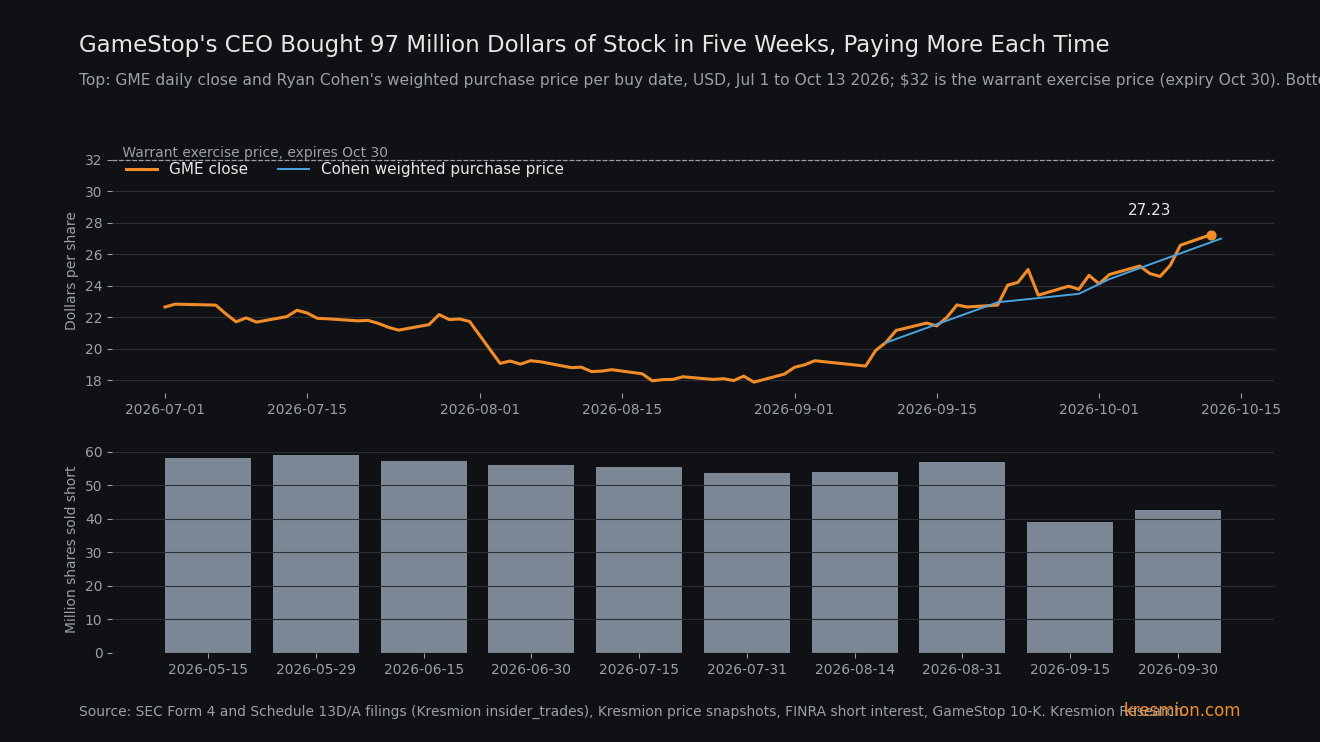
Ryan Cohen, GameStop's CEO, bought 4,144,810 shares for $97,192,416 in open-market purchases between September 10 and October 13, 2026, none on a 10b5-1 plan. His weighted price rose on every buy date, from 20.38 to 26.98. The spend equals 91% of what his directly held shares had cost through January 6, according to his own Schedule 13D/A filings. His stake, counting warrants, went from 8.3% on September 3, after a share issuance, up to 9.1%, against 9.3% after his last January purchase. The volume and short interest data show other flows were far larger than his. A block of 59,088,333 warrants with a $32 exercise price expires on October 30. This note describes the trades. It does not forecast the price.
Key takeaways
| What | Number |
|---|---|
| Cohen purchases, September 10 to October 13 | 4,144,810 shares, $97,192,416, 7 rows, all transaction code P, none on a 10b5-1 plan (Kresmion insider_trades, checked against the Form 4s for September 10 and October 13) |
| Weighted price by buy date | 20.38 (Sep 10), 22.94 (Sep 21), 23.48 (Sep 29), 24.41 (Oct 2), 26.98 (Oct 13) |
| Against his cost basis | 91.0% of the roughly $106.85M his direct stake cost as of January 6; 43.1% of the current roughly $225.41M (Schedule 13D/A amendments 12 and 21) |
| Stake | 42,492,652 shares held directly. With 3,734,784 warrants, 9.1% of the company on October 13, after 9.3% in January and 8.3% on September 3 |
| Share count | 448,009,480 (December 5, 2025) to 504,500,990 (September 3, 2026), up 12.6%, almost all of it in one month through a convertible note exchange (8-K, August 31) |
| Limits | His shares were 1.36% of GME volume from September 10 to October 12. FINRA short interest fell 17,920,900 shares (31.4%) in the August 31 to September 15 window, when he bought 1,000,000 |
| The calendar | 59,088,333 warrants (count at January 31) struck at $32.00 expire at 5pm New York time on October 30. The close on October 13 was $27.22, so the strike is 17.6% above it |
What the data shows
Kresmion's insider_trades table (ticker GME, trade dates from January 1 2026, latest trade date October 13) holds seven Cohen rows in the window, all code P, the code for an open-market purchase. By date: 1,000,000 shares at 20.3759 on September 10; 1,150,680 at 22.9375 on September 21; 446,500 at 23.4753 plus 3,500 at 23.4499 on September 29; 700,000 at 24.4061 on October 2; and 67,130 at 26.75 plus 777,000 at 27.00 on October 13. The weighted average is about 23.45. The SEC Form 4s for September 10 and October 13 match, and the October 13 filing shows the 10b5-1 box unchecked (Form 4, October 13).
Direct holdings went from 38,347,842 shares before the first buy to 42,492,652 after the last, up 10.8%.
The scale comes from his Schedule 13D/A filings, which report what his directly held shares cost. Amendment 12 (January 6) shows 37,347,842 shares at about $106,851,057. After his January 20 and 21 purchases of 500,000 shares each, Amendment 14 shows 38,347,842 shares at about $128,210,281. Amendment 21 (October 13) shows 42,492,652 shares at about $225,408,469. The cost basis rose $97,198,188 from January 21 to October 13, against $97,192,416 summed from the Form 4s, a gap of $5,772. Both come from the same filer and law firm, so the match checks the arithmetic and adds no independent confirmation.
The stock closed at 18.89 on September 8 and 19.89 on September 9, the day before his first buy. It closed at 27.23 on October 12, up 44.2% from September 8, and at $27.22 on October 13 (Stocktwits). The October 12 close is the highest in our price table since October 1, 2025, but that table has gaps (229 rows since October 12, 2025), so treat that as approximate. At $27.22 the market value is about $13.73B on 504.5M shares. The data does not show what drove the stock's rise.
The mechanism
Three facts sit side by side. The only reason we found in his 2026 Schedule 13D/A amendments (12 to 21) is from January: Amendment 14 says a CEO should buy shares in the open market with personal funds to strengthen alignment with stockholders. The six amendments filed during the buying (16 to 21, September 10 to October 13, all linked in Sources) do not amend Item 4 or give another reason.
A diluted stake. GameStop's share count rose 12.6% between December 2025 and September 2026. Almost all of it came in one month: the 10-Q shows 449.1 million shares at August 1 and 504,500,990 on its September 3 cover page, and GameStop's August 31 8-K says holders of about $1.4 billion of convertible notes were to receive about 55.5 million shares plus $358.4 million in cash, closing on or about September 3. Cohen's stake, counting 3,734,784 warrants, fell from 9.3% in January to 8.3% on September 3 without him selling anything. It was 8.7% on September 21 and 9.1% on October 13. His percentage is back near January's level.
Buying into a rising price. His weighted price rose on each of the five buy dates while the stock climbed from 18.89 to 27.23. This is the opposite of averaging down. The 13D/A says the funds may at times include margin loans.
A dated capital event. Holders may exercise at any time before expiry. If GME trades above $32 at expiry, holders can pay the company about $1.89B in cash (59,088,333 times $32) for new shares, about 11.7% of the current count. Below $32 they expire and the company receives nothing. Exercise proceeds were $0.1M in the six months to August 1 (10-Q). None of his 2026 amendments (12 to 21, all linked in Sources) links the buying to the warrants, so no link is asserted.
The second-order point: the dilution that cut his stake is also the main risk to the stake as it stands now. Full exercise would put his 46.2M shares and warrants over about 563.6M shares, roughly 8.2%, a cut of about a tenth. That is our arithmetic and assumes every warrant is exercised.
Other explanations
Ownership maintenance. The stake, at 9.1%, is 0.2 points below January's 9.3%. This is one possible reading and was not tested.
Other flows drove the price. Short interest dropped by 17,920,900 shares in the August 31 to September 15 settlement window. The stock also rose 5.3% on September 9, a day before his first buy and the filing date of the 10-Q. Possible causes, none tested and magnitude unknown: covering by holders who had shorted stock against the warrants (the hedge ratio of an option below its strike shrinks as expiry nears), or ordinary short covering after quarterly results. A further documented possibility is the exchange of convertible notes for stock, due to close on or about September 3, before his first buy. GameStop's August 3 release said participating noteholders might buy or sell shares or unwind hedges in the open market, and that the effect on the price may be material.
Deal or strategy positioning. On May 3 GameStop proposed buying eBay at $125.00 per share, half cash and half GME stock, about $55.5B in equity value (GameStop). The 10-Q says GameStop exercised its put/call pairs in the second quarter and holds eBay stock directly, with $4,386.3 million of cash paid for the equity investment in the six months to August 1. The June 26 outlook release says management remains focused on advancing the proposed acquisition. The bid's current status is unverified, so this cannot be weighed.
Personal reasons. Tax, liquidity or estate planning cannot be seen in filings.
The base rate
On his own history, the cost basis covers every share he holds directly. His stake cost about $106.85M through January 6, and his only other 2026 purchases were the 500,000 shares on January 20 and 500,000 on January 21, together about $21.36M. The five weeks equal 91% of that cost. We make no "largest ever" claim, because purchases from 2020 to 2023 were not pulled, and a June 2023 amendment was not read.
Across the market, Cohen's $97.19M is the largest of 90 buyers with a CEO title making non-plan code-P purchases from September 10 to October 13. The median among all 472 non-plan buyers was $128,595. Only Berkshire (LEN), Baker Bros (KOD), Cascade (RSG) and Conifer (GPI), all investment entities, bought more. The ranking came from a screen sorted by size, so it describes the sample and tests nothing. The table is dense only from August 2026 (12,077 rows in August, 1,228 in July) and misses his January purchases, so it offers no multi-year base rate.
Other GameStop insiders since September 8: directors Cheng ($1,033,956 on September 8), Grube ($196,076 on September 9), Attal ($100,000 on September 10 and $401,958 on September 21) and Turner ($254,540 on October 1) bought. Cheng and Grube bought before Cohen's first buy. The company's PFO, Moore, sold $177,025 on October 1 (not on a plan) and $417,960 on October 12 (10b5-1 plan, at $27.00).
On short interest, the September 15 drop is the largest of 9 changes across the 10 settlements we hold, May 15 to September 30. That is about five months of data.
The evidence against
The strongest point against reading this as a signal on the price is size. From September 10 to October 12, 242,662,300 shares traded over 23 sessions, and Cohen's 3,300,680 were 1.36% of them. On single days he was 8.6% (September 10) and 11.8% (September 21). Average daily volume was 5,711,100 from June to August and about 10.55M from September 10 to October 12, 1.85 times higher.
In the August 31 to September 15 window, short interest fell from 56,990,026 to 39,069,126 shares, 17.9 times his 1,000,000. It was 42,673,721 at September 30, 8.46% of 504.5M shares. The move began before his first trade, and his stake, counting warrants, went from 8.3% on September 3 to 9.1%, against 9.3% in January. The note exchange was due to close about September 3, before his first buy. Moore's sales came at prices close to his.
Not done: no price-impact test, the eBay bid's current status, the original Schedule 13D and the June 2023 amendment. We examined about 14 GME statistics, so single comparisons should be read with that in mind.
What would change the read
1. October 30, 5pm New York: the warrants expire. Whether GME trades above $32 decides if any cash comes in. Exercise counts appear in the next 10-Q. 2. FINRA settlement of October 15 (published late October): further falls from 42,673,721 would give short covering more of the move; a rebuild points the other way. 3. Any Cohen Form 4, due within two business days of a trade. A sale, or no buys after October 13, would end the pattern. 4. The next 13D/A: stake against 9.1% and 504,500,990 shares. The note exchange was due to close on or about September 3, before his first buy, so that count already includes it. 5. Any GameStop or eBay filing on the bid. The last company statement on the bid we fetched is the June 26 release.
The warrants' exercise price is $32.00, and the stock closed at $27.22 on October 13.
Frequently asked questions
How much did Ryan Cohen buy and at what price?
He bought 4,144,810 GME shares for $97,192,416 from September 10 to October 13, 2026, at a weighted average of about $23.45. His weighted price was 20.38, 22.94, 23.48, 24.41 and 26.98 on the five buy dates.
Were the purchases on a 10b5-1 plan?
No. All seven rows are open-market code P purchases, and the Form 4 for October 13 shows the 10b5-1 box unchecked.
Is this a record purchase for him?
Unknown. It equals 91% of what his direct stake cost through January 6, but we did not pull his purchases from 2020 to 2023.
Why does his percentage matter?
GameStop's share count rose 12.6%, which cut his stake from 9.3% to 8.3% without a sale. The buying brought it to 9.1%, counting 3,734,784 warrants.
What are the GameStop warrants?
59,088,333 warrants (count at January 31) with a $32.00 cash exercise price, expiring 5pm New York time on October 30. Full exercise would bring about $1.89B and add about 11.7% to the share count.
Did his buying move the stock?
The data does not show it. He was 1.36% of volume from September 10 to October 12, and short interest fell 17,920,900 shares in a window when he bought 1,000,000. Magnitude of any effect is unknown.
Sources
SEC Form 4, Ryan Cohen, October 13, 2026: 844,130 shares at 26.75 and 27.00, 42,492,652 held after, 10b5-1 box unchecked.
SEC Form 4, Ryan Cohen, September 10, 2026: 1,000,000 shares at 20.3759, 39,347,842 held after.
Schedule 13D/A Amendment 21, October 13, 2026: cost basis about $225,408,469, 9.1% stake, 504,500,990 shares, 3,734,784 warrants.
Schedule 13D/A Amendment 12, January 6, 2026: cost basis about $106,851,057 on 37,347,842 shares.
Schedule 13D/A Amendment 14, January 21, 2026: 500,000 shares at 21.6010, cost basis about $128,210,281, 9.3% stake, and an Item 4 statement that a CEO should buy shares in the open market with personal funds to strengthen alignment with stockholders.
Schedule 13D/A Amendment 13, January 20, 2026: 500,000 shares at 21.1174, 9.2% on 448,009,480 shares.
Schedule 13D/A Amendment 15, September 3, 2026: 8.3% stake, no trades in the prior 60 days.
Schedule 13D/A Amendment 16, September 10, 2026: 1,000,000 shares at 20.3759, 8.5% stake.
Schedule 13D/A Amendment 17, September 21, 2026: 1,150,680 shares at 22.9375, 8.7% stake.
Schedule 13D/A Amendment 18, September 29, 2026: 446,500 shares at 23.4753 and 3,500 at 23.4499, 8.8% stake.
Schedule 13D/A Amendment 19, September 29, 2026: no transactions since Amendment 18, 8.8% stake.
Schedule 13D/A Amendment 20, October 2, 2026: 700,000 shares at 24.4061, 8.9% stake. None of Amendments 15 to 21 amends Item 4.
GameStop 10-K Exhibit 4.1: 59,088,333 warrants at January 31, $32.00 exercise price, expiry October 30 at 5pm New York time.
GameStop 10-Q, quarter ended August 1, 2026: 449.1 million shares at August 1, 504,500,990 on the September 3 cover page, warrant exercise proceeds of $0.1M, and $4,386.3 million cash paid for equity investment in the six months to August 1.
GameStop, eBay proposal, May 3, 2026: $125.00 per share, half cash and half stock, about $55.5B.
GameStop, withdrawal of CEO performance award, June 23, 2026: the Board granted Cohen's request to remove the proposed award from the proxy. The award terms (171,537,327 options at $20.66) are in Schedule 13D/A Amendment 12.
GameStop, Form 8-K, August 31, 2026: exchange of about $400M of 2030 notes and $1.0B of 2032 notes for about 55.5M shares and $358.4M in cash, closing on or about September 3.
GameStop, convertible notes release, August 3, 2026: participating noteholders may buy or sell shares or unwind hedges in the open market, and the effect on the price may be material.
GameStop, fiscal 2026 outlook, June 26, 2026: adjusted EBITDA above $600M against $345.4M.
Stocktwits, October 13, 2026: GME close of $27.22.
Kresmion tables: insider_trades, company_price_snapshots, short_interest (FINRA, latest settlement September 30) and company_shares.