
By Kresmion Research, October 27, 2026
Medtronic short interest reached 139.0 million shares at the October 15 settlement, 8.1 times the September 15 level, as its MiniMed share swap closed. FINRA published the figure on October 26. It is 7.3 times the highest reading from May to September, and it is the largest one-settlement addition among 7,260 tickers. Medtronic's own press releases explain the timing: holders tendered 23 percent of the company's shares into the MiniMed exchange offer, only a fraction was accepted, and the rest came back. Our read is that the build is tied to the exchange offer, but the data cannot say whether it is hedging by tendering holders, option dealers, arbitrage pairs or outright bets. ORTEX estimates the short more than tripled between October 7 and October 9, before tendering holders could legally sell short. The read is an inference from the offer mechanics. Short-surge screens, including our own, read it as a short build.
Key takeaways
| What | Number |
|---|---|
| MDT short interest, October 15 settlement | 139,004,337 shares. That is 8.07 times September 15 (17,229,743) and 7.28 times the May to September high (19,087,345 on June 30) (FINRA via Kresmion short_interest) |
| One-settlement addition | +99,030,107 shares, rank 1 of 7,260 tickers. The next largest was AAL at +25,746,416, 3.85 times smaller. Also the largest of all 78,839 rows we hold, May 15 to October 15 (Kresmion short_interest) |
| MiniMed exchange offer | 297,521,390 MDT shares tendered, 23.3 percent of 1,279.1 million outstanding. 55,032,401 accepted, 242,488,989 returned. The short equals 57.3 percent of the returned shares (Medtronic releases, Kresmion company_shares) |
| MDT volume | 105.7 million shares on October 8, the largest of 2,396 sessions from April 17, 2017, against an average of 6.2 million (Kresmion company_price_snapshots) |
| Days to cover | 2.93 as stored. On the 2017 to 2026 average volume the same short is 22.3 days |
| Prices | MDT 88.48 (October 9) to 95.45 (October 15), plus 7.9 percent. MMED 19.71 (October 9) to 16.81 (October 14), minus 14.7 percent. Context only |
| The test | The October 30 settlement, published November 10 (Equibles, derived from FINRA rule) |
What the data shows
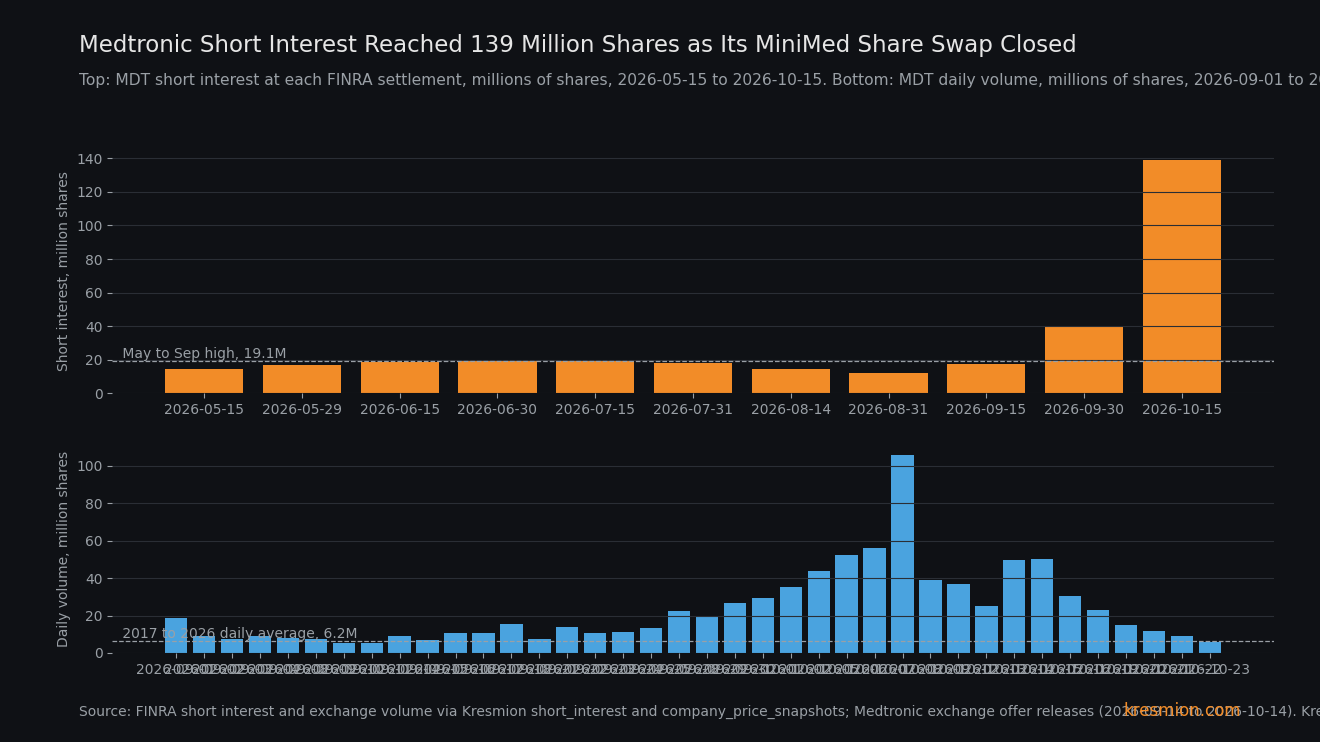
Medtronic's short interest ran between 12.1 million and 19.1 million shares at every FINRA settlement from May 15 to September 15 (the low was 12,134,511 on August 31, the high 19,087,345 on June 30). It was 17,229,743 on September 15, 39,974,230 on September 30 and 139,004,337 on October 15. The October 15 row was fetched from our short_interest table on October 27 at 00:37 UTC.
The addition of 99,030,107 shares in one settlement is the largest of the 7,260 tickers reported at that settlement. Medtronic ranks 20th by the level of its short, well below Transocean at 312.7 million and Nvidia at 301.6 million. The unusual part is the one-settlement jump.
Trading volume moved with it. MDT traded 105,664,000 shares on October 8, the largest of the 2,396 sessions we hold from April 17, 2017 to October 26, 2026. The 2017 to 2026 average is 6,224,685 shares a day, and the 17 sessions from October 1 to October 23 averaged 36.3 million. Volume was back to 6,009,000 on October 23.
The context is on Medtronic's website. On September 14 the company launched an offer letting its holders swap MDT shares for MiniMed (MMED) stock at a 7 percent discount, up to 4.5939 MMED per MDT share. Medtronic owned 252,813,348 MMED shares, about 90 percent of the company, and offered up to 225,361,295 of them plus 27,452,053 more if the offer was oversubscribed. The offer and withdrawal rights expired at midnight New York time at the end of October 9. The final ratio was set at the 4.5939 limit because the formula would have produced more than the limit.
Holders tendered 297,521,390 MDT shares. Medtronic accepted 55,032,401 for all 252,813,348 MMED shares, a proration factor of 18.289133 percent, with 757,890 odd-lot shares not prorated. Unaccepted shares were returned in book-entry form. That leaves 242,488,989 shares that were tendered, held by the exchange agent, and handed back.
Our records agree that the event was large, but not on its timing. FINRA shows 39,974,230 shares at the September 30 settlement. ORTEX's lending-based estimate was 17.4 million on September 30 and about 37.5 million on October 7, then 129 million on October 9. The two series measure different things and we cannot reconcile them. They all describe one corporate action, so they say nothing independent about motive.
The mechanism
Tendering paid. At October 9 closing prices, 4.5939 MMED at 19.71 was worth 90.55, against 88.48 for a share of MDT, 2.3 percent more (the offer formula used its own averaging, so this is an approximation). Slightly more than 23 percent of Medtronic's shares were tendered for a slot that fit about 18.5 percent of the tendered shares.
A tendered share cannot be sold until it comes back. A holder who tendered could not sell those shares, and could not know until October 14 how many would be exchanged. Rule 14e-4 adds a second constraint: it is unlawful to tender in a partial tender offer unless the tenderer is net long the tendered amount at the time of tender and at the end of the proration period (eCFR). A short position under the rule covers shares sold, borrowed, or calls written, with conditions. Bought puts are not on the list.
That gives two routes to a short with no opinion behind it. Before expiry, a tenderer could buy puts, and option dealers then sell MDT to hedge those puts. ORTEX logged a put/call ratio of 0.93 on October 7 and 8, against 0.70 in its latest reading, and ORTEX notes the higher reading did not persist. We have no size for any put-hedge route. After expiry, the cleanest way to lock the value of shares a holder owns but cannot deliver is to borrow and sell MDT, then close the short with the returned shares. ORTEX recorded the cost to borrow MDT at 18.5 percent on October 13, up from 0.67 percent the session before.
Three second-order points follow.
First, both standard denominators mislead. Days to cover reads 2.93 because the divisor is offer-inflated volume of 47.5 million shares a day. On normal 2017 to 2026 volume the same short would be about 22 days. Neither number describes positions that can be closed by delivering returned shares, with no open-market buying needed.
Second, short-surge screens read this as a short build. Our own SHORT_INTEREST_SURGE flag scored it 95, the same score 54 other tickers carry at that settlement, so the score does not separate it. Ranked by shares added, it is first. An ORTEX auto-generated note of October 14 (an ORTEX estimate, not a FINRA figure) estimated shorts at 119.5 million shares on October 13, 9.3 percent of free float, with a peak of 129 million on October 9. That note does not mention the exchange offer. A corporate-action calendar has to be joined to short data before a surge is read as sentiment.
Third, the larger move was in MiniMed. MMED fell 14.7 percent from 19.71 on October 9 to 16.81 on October 14, on volume of 67,620,800 shares, as 252.8 million shares reached new holders. MMED short interest went from 8,060,409 on August 31 to 18,197,982 on September 30 and 20,704,820 on October 15. MDT rose 7.9 percent over October 9 to October 15 while its short base grew. We cannot size the price effect of the offer, or how much of either move came from it.
Other explanations
A directional bet against post-separation Medtronic is the reading a short-build screen implies. ORTEX's note describes a structural repositioning and says the build is not purely an earnings hedge, without mentioning the exchange offer. MDT rose from 88.48 to 95.45 between October 9 and October 15 while the short base grew, and volume fell back to 6.0 million by October 23. ORTEX notes the next earnings date is November 24 and that analyst targets were raised after the September 1 report. A new fundamental short of 139 million shares built in four weeks with no catalyst would be unusual. Still, nothing in our data rules out that part of the 139 million is outright.
Pre-expiry hedging by options dealers, or pair trades by holders who did not tender, is the second alternative. FINRA's 40.0 million at September 30 and ORTEX's estimated peak on October 9 both fall before tenderers could legally be net short, although the two series disagree on how early the build began. This differs from a tendering-holder hedge only in who holds the short. The shorts would still be tied to the offer.
The standard arbitrage in a swap like this runs the other way: buy MDT, tender, and short MMED. That would add MMED shorts, which fits the rise in MMED short interest from 8.06 million to 20.70 million (although it was already 13.59 million at the September 15 settlement, the day after the offer launched, so 5.53 million of the 12.64 million rise was in place by the first settlement of the offer), and it would put buying, not shorting, into MDT. We cannot see these trades.
A reporting artifact is the third. Sales of shares in transit could be marked short, or the FINRA file could contain an error. This is less likely, because ORTEX's separate lending data shows a position of similar size (119.5 to 129 million shares) and a borrow-cost jump. But broker marking of tendered or returned shares can inflate the FINRA count, and we cannot audit it.
The base rate
Our short_interest table holds 78,839 rows across 11 FINRA settlements, May 15 to October 15, 2026. Of those, 11,844 started from a short base of at least 10 million shares. Only 5 of them (0.04 percent) at least tripled in one settlement: BBD on May 15, CVNA on May 15, CNQ on May 29, SPCX on June 30 and MDT on October 15. Only 8 rows added 50 million shares or more in one settlement, and MDT's 99.0 million is the largest.
Three limits apply. Our short series is only 11 settlements long, and we have not checked FINRA's full Medtronic history, so we do not call this a record. We have no sample of past split-offs, so we cannot say how quickly offer-related shorts usually unwind. And the selection matters: we screened 7,260 tickers at the October 15 settlement and MDT was the top change, so its extremeness was selected for and we make no predictive claim from it. We also compared the float ratio: the stored short is 10.871 percent of 1,278,685,547 float shares, with float sourced from insider data at medium confidence.
The evidence against
The strongest point against a hedge by tendering holders comes from timing. ORTEX puts the peak at 129 million shares on October 9, the last day of the offer, when Rule 14e-4 still required anyone tendering to be net long. FINRA's short had also already more than doubled to 40.0 million by September 30, before anyone knew the proration factor. ORTEX had only 17.4 million that day. So a large part of the build was held by parties who were not, at that moment, hedging tendered shares: option dealers, holders who did not tender, or outright shorts.
Someone also paid an 18.5 percent annualised borrow fee on October 13 to keep a short open. That is an expensive hedge. Paying it fits conviction as well as hedging. We cannot see who holds the 139 million shares.
What would change the read
The FINRA settlement of October 30 is published on November 10 (filing November 3). If MDT short interest is still above 100 million shares there, more than two weeks after Medtronic announced the final results (October 14), the read that the build is tied to the offer weakens and outright shorts become more likely. A fall back toward the May to September range of 12.1 to 19.1 million shares would fit offer-related hedges closing, and it would also fit outright shorts being covered. The following settlement, November 13, is published on November 24, the date ORTEX lists for Medtronic's next earnings. MDT's last stored short reading is 139,004,337 shares at the October 15 settlement.
Frequently asked questions
Is the 139 million share short a bet against Medtronic?
We think the build is tied to the MiniMed exchange offer, but we cannot see who holds the shares, and ORTEX dates most of its estimated build to October 8 and 9, before tendering holders could legally sell short. MDT rose 7.9 percent from October 9 to October 15 while the short grew. Part of the 139 million could still be outright.
What was the MiniMed exchange offer?
Medtronic let its holders swap MDT shares for MiniMed stock at a 7 percent discount, capped at 4.5939 MMED per MDT share. Holders tendered 297,521,390 shares, Medtronic accepted 55,032,401, and 242,488,989 were returned in book-entry form.
Why does days to cover mislead here?
The stored figure is 2.93 days because it divides by volume of 47.5 million shares a day, inflated by the offer. On the 2017 to 2026 average of 6.2 million, the same short is about 22 days. Neither figure fits shorts that can be closed with returned shares, without buying in the market.
Is this a record short interest?
We cannot call it one. It is the largest one-settlement addition among the 78,839 rows we hold, but our series covers only 11 settlements, and we have not checked FINRA's full Medtronic history.
When will we know more?
FINRA publishes the October 30 settlement on November 10. The following settlement, November 13, is published on November 24.
Sources
Medtronic, Final Results of MiniMed Group, Inc. Exchange Offer, October 14, 2026: 297,521,390 tendered, 55,032,401 accepted, proration 18.289133 percent, returned shares in book-entry form.
Medtronic, Final Exchange Ratio of 4.5939, October 7, 2026: upper limit in effect, expiry at midnight at the end of October 9.
Medtronic, Exchange Offer Launch, September 14, 2026: 7 percent discount, 4.5939 cap, 252,813,348 MMED shares.
eCFR, 17 CFR 240.14e-4: net long requirement at tender and at the end of the proration period, and the definition of a short position.
ORTEX News, October 14, 2026: lending-data estimates of short size, borrow cost of 18.5 percent on October 13, put/call ratio (ORTEX estimates, AI-generated note).
Equibles, Short Interest Reporting Dates 2026: the October 30 settlement published November 10.