By Kresmion Research, October 21, 2026
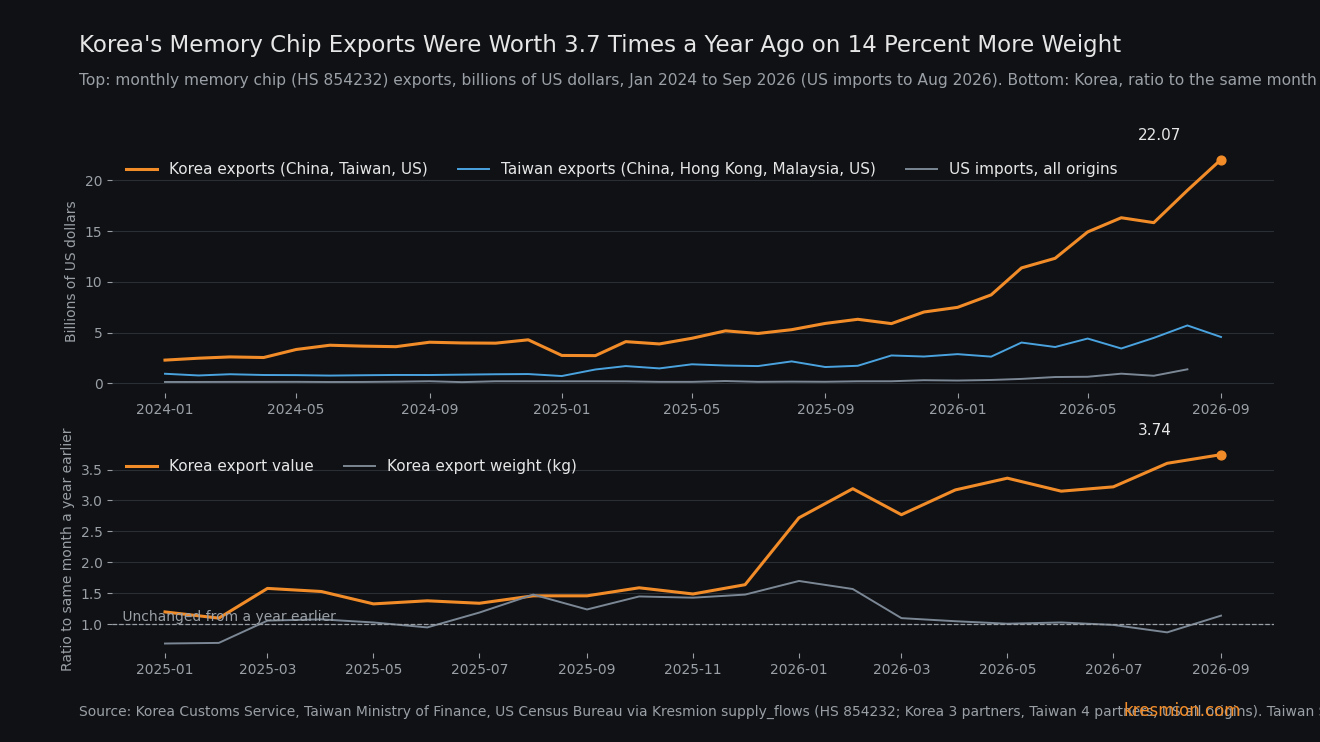
Korea shipped $22.07B of memory chips in September 2026, 3.74 times the $5.91B of a year earlier, on only 13.8% more weight (183,504 kg against 161,194 kg). The figures are Korea customs data for HS code 854232 across the three partners Kresmion carries: China, Taiwan and the US. Value per kilogram went from $36,647 to $120,241, a 3.28-fold rise, and Taiwan's customs data for the same code show the same pattern. The likeliest reading is that a memory price shock is being recorded in dollars. Customs data cannot split price from product mix, and value per kilogram fell in September from August, so the data cannot say how large the price effect is.
Key takeaways
| What | Number |
|---|---|
| Korea 854232 exports, September 2026 vs September 2025 | $22.07B vs $5.91B, 3.74x; weight 183,504 kg vs 161,194 kg, +13.8%; value per kg $120,241 vs $36,647, 3.28x (Korea Customs Service via Kresmion supply_flows, three partners) |
| Taiwan 854232 exports, same months | $4.57B vs $1.61B, 2.84x, on 15% less weight (257,206 kg vs 302,401 kg); value per kg 3.34x. Four partners; September is a first print (Taiwan Ministry of Finance via Kresmion) |
| Korea year-on-year value ratio | 1.10x to 1.64x in every month of 2025; 2.72x in January 2026 and 2.77x to 3.74x in every month through September (Korea Customs via Kresmion) |
| Korea, January to September 2026 | $128.10B, 3.27 times the $39.21B of January to September 2025 and 2.19 times all of 2025 ($58.44B) |
| Buyers | IDC counted Q3 smartphone shipments down 22.0% to 255.3 million, which it calls the largest decline it has recorded, and PCs down 20.1% to 62.7 million (preliminary). IDC says memory costs are up about 350% from a year ago |
| Where it went | 69.1% of the three-partner total ($15.25B of $22.07B) went to China, 29.3% to Taiwan and 1.6% ($0.36B) to the US. Kresmion carries no other Korean partners for this code, so the data cannot say what share of Korea's total 854232 exports this is |
| October so far | Korea Customs, October 1 to 20, all chips: exports +222.5% to $27.5B, 44.7% of total exports (Korea Times, relaying Yonhap) |
What the customs data shows
Korea's September value is the highest of the 81 months in Kresmion's history for this code (January 2020 to September 2026). The prior monthly high was $19.025B in August 2026. Value per kilogram ranks second of 81; August 2026, at $138,706, is first.
The step is sharp. Through 2025 the year-on-year value ratio stayed between 1.10x and 1.64x. In January 2026 it jumped to 2.72x ($7.49B against $2.75B; the January 2025 base was weak, and December 2025 was already $7.03B), and it has run between 2.72x and 3.74x in all nine months since. Weight tells a different story: the weight ratio for March to September 2026 sat between 0.87x and 1.14x. Over those months value ran far above a year earlier while kilograms stayed roughly where they were. The January and February 2026 weight ratios were higher, at 1.70x and 1.57x, against a weak early 2025.
Taiwan's customs series says the same. September value was $4.57B against $1.61B (2.84x), on 15% less weight, and value per kilogram rose 3.34x. Taiwan's August, at $5.707B, is the highest of 141 months (January 2015 onward) and September is second. Taiwan's September rows are first prints and may be revised.
Over nine months, Korea's total of $128.10B is already more than three times the highest full year from 2020 to 2024 ($40.58B, in 2024). Taiwan's $35.72B for January to September compares with a pre-2025 annual peak of $16.72B in 2022 (Kresmion's Taiwan data begin in 2015).
Scope matters. The $22.07B covers one customs code and three partners. Korea's September rows are also a first print (first loaded October 15) and may be revised. Korea's headline semiconductor exports were +263% to $60.3B in September, with total exports at a record $120.9B (Korea Times, October 1). Those are broader categories and not the same series.
The mechanism
The buying side shows the cost. IDC counted global smartphone shipments down 22.0% year on year in the third quarter to 255.3 million, from 327.3 million, and said memory costs have surged about 350% since last year. Its preliminary PC count fell 20.1% to 62.7 million from 78.5 million, a figure relayed by KitGuru. Memory is an input in both. Korea's memory export value to three partners rose about 3.7 times while IDC counted fewer phones and PCs. TrendForce says capacity is going to servers, so some of that value does not go into phones or PCs and it is not the same as device makers' memory spending. IDC ties the phone decline to memory costs. For PCs, IDC attributes the 20.1% drop partly to vendors stocking up in the first half of 2026 ahead of memory price rises, which pulled volume out of Q3.
The supply side, per TrendForce on September 30, is that suppliers prioritize server capacity, and PC DRAM supply may fall in 2027. If more capacity serves servers, less is left for conventional and mobile memory, and contract prices for those parts rise. Customs data records dollars and kilograms, so a price shock appears as value per kilogram climbing while weight stays flat: 3.28x in Korea and 3.34x in Taiwan. Customs value per kilogram (about 3.3x) and IDC's bill-of-materials estimate (+350%, which is 4.5 times) come from different methods and agree in direction and the same order of magnitude. That convergence is about measuring the price. It does not prove why prices rose.
Two second-order points follow.
First, part of Korea's dollar export figures may now be tracking memory prices more than physical volume. In the 854232 series, which is roughly a third of September's $60.3B semiconductor exports (different sources, so approximate), value rose far faster than weight. Yonhap attributes the headline gain to both higher shipments and higher prices, and chips were 44.7% of Korea's exports in the first 20 days of October, up 16.2 points. The data cannot say how the rise for all chips splits between price and volume.
Second, the comparison base gets harder through 2027. Korea's monthly value did not step up in one month. It rose from $7.49B in January 2026 to $22.07B in September (the January 2026 ratio of 2.72x was lifted by a weak January 2025 at $2.75B). If monthly value stayed at September's $22.07B, the year-on-year ratio would be 2.95x against January 2026, 1.94x against March and 1.00x against September. TrendForce already projects conventional DRAM contract prices rising more slowly, 10 to 15% quarter on quarter in Q4 (NAND 15 to 20%). A falling ratio during 2027 would be arithmetic and says nothing about demand by itself.
The US view also understates the flow. Only $0.36B ($0.355B, 3,501 kg) of Korea's September 854232 shipments to the three partners Kresmion carries went directly to the US, against $15.25B to China and $6.46B to Taiwan. US Census imports of the code from all origins were $1.383B in August 2026 against $0.170B a year earlier, 8.13x, but from a small base. A reader who looks only at US data sees a small number. Among the three Korean partners Kresmion carries, China received the most value, and the final use of those chips is not in the data. Korea's total exports to the US, all goods, rose 137% to $24.33B in September (Korea Times, October 1), so the small 854232 figure describes one code only.
As context only: Micron (MU) closed at $896.07 on October 20. Customs data says nothing about any one company's sales.
Other explanations
Mix shift. Higher-value stacked or high-capacity server parts raise value per kilogram with no price change on any given part. The Korea-to-China lane's value per kilogram rose 4.88x ($99,136 against $20,314) while the Korea-to-Taiwan lane's rose 2.18x ($246,590 against $113,342). That gap fits a mix change on the China lane. Against it, IDC's independent cost estimate and TrendForce's contract prices point to like-for-like price rises, and Taiwan's data show the same 3.3x. Most likely both are at work. Customs data cannot separate them or say how much each contributes.
Stockpiling ahead of export controls or tariffs. A rush of China-bound shipments would lift value, but it should lift weight too. Korea-to-China weight rose only 17% (131,015 kg to 153,795 kg) while value rose 5.7x. That does not fit a pure volume stockpile. Stockpiling of higher-value parts cannot be excluded, and the data cannot say how large it would be.
Currency. The customs agencies report values in dollars. We did not query won or Taiwan dollar history, so the currency effect cannot be sized.
Double counting. Korea's and Taiwan's totals could overlap through transshipment, but this note never adds them. Each ratio is computed inside one customs series.
The base rate
Korea's September value ranks first of 81 months and its value per kilogram second of 81. Its 3.74x ratio is the highest of the 69 months with a year-ago comparison (January 2021 onward). Before 2026 the highest was 2.07x, in 2024. Annual totals for the code were $31.26B (2020), $38.48B (2021), $36.35B (2022), $22.37B (2023), $40.58B (2024) and $58.44B (2025).
A move of 12.8% in monthly value per kilogram is one standard deviation in both series, so single-month changes are noise and the 12-month ratios are the measure. A ratio that ran between 1.10x and 1.64x through 2025 and then held between 2.72x and 3.74x for nine months, with the highest levels in Kresmion's history in two series of 81 and 141 months, is far outside what a search of this size would produce by chance. We also checked several other HS codes and desks. The Korea and Taiwan series come from separate agencies, but both measure one driver, the memory price cycle, so they count as one confirmation. The Korea Times figures are the same official data relayed. IDC's statement that the 22.0% phone decline is its largest on record is IDC's own, and we did not check its history.
The evidence against
Value per kilogram fell in September in both series. Korea went from $138,706 to $120,241 (-13.3%) and Taiwan from $20,045 to $17,767 (-11.4%), while Korea's weight rose 33.8% on the month (137,160 kg to 183,504 kg). That fits IDC's comment that memory inflation slowed to a low double-digit sequential rise in the third quarter, and TrendForce's slower fourth-quarter projection. If the per-kilogram level has peaked, the price half of the story is already ageing.
Each fall is about one standard deviation of the monthly distribution. Korea's is the 9th lowest of 80 monthly changes since February 2020 (median +3.3%), and Taiwan's the 10th lowest of 140 (median +1.5%). Taiwan's September data is a first print, and today's Korea Customs read, October 1 to 20, still shows chip exports up 222.5%. The second counterpoint is the China lane's 4.88x, far above the Taiwan lane's 2.18x: part of the measured price may be mix.
What would change the read
Korea's October 854232 customs detail is the first test. Kresmion's table loaded September's data on October 15, so October should arrive around November 15. The Ministry's headline release on Sunday, November 1 will show total chip exports only. If October value per kilogram falls below July's $113,781 while weight holds, or the year-on-year value ratio drops below 2.72x, the 2026 low, the price reading weakens. US Census product-level imports for September come after the BEA's November 4 trade release (Kresmion loaded August on October 16, so mid November is likely). A fall in 854232 imports from all origins below $1.383B would show whether the US lane is easing. Taiwan's October data should load around November 10 (September loaded October 12; exact release date not verified), along with any revision to the September first print of $4.570B. TrendForce's first-quarter 2027 contract price guidance matters too: a flat or negative quarterly call would undercut the price mechanism. IDC's next quarterly tracker, for the fourth quarter, is due in January 2027. As of today's Korea Customs release, chip exports for October 1 to 20 were $27.5B, up 222.5% from a year earlier.
Frequently asked questions
How can exports triple when the weight barely changed?
Customs records value and weight separately. Korea's September 854232 value was 3.74 times a year earlier while weight rose 13.8%, so value per kilogram rose 3.28x. That fits a price rise, a shift toward higher-value parts, or both. Customs data cannot say how much of each.
Is demand for memory chips rising?
The data here records export dollars and cannot measure demand. IDC counted smartphone shipments down 22.0% and PC shipments down 20.1% in the third quarter (preliminary); for PCs IDC cites inventory front-loading earlier in 2026 as part of the cause. TrendForce says suppliers prioritize server capacity.
Are Korea's record exports a sign of more physical trade?
Possibly in part. In the 854232 series value rose 3.74x while weight rose 13.8%, but that series is about a third of Korea's semiconductor exports (different sources, so approximate), and Yonhap cites both higher shipments and higher prices for the headline gain. In the first 20 days of October chips were 44.7% of Korea's exports.
Why might the year-on-year numbers fall in 2027?
Because Korea's monthly value rose from $7.49B in January 2026 to $22.07B in September 2026. If monthly value stayed at September's level, the year-on-year ratio would fall to 2.95x against January 2026, 1.94x against March and 1.00x against September. TrendForce projects slower DRAM contract price growth of 10 to 15% in the fourth quarter.
Why does the US see so little of it?
Only $0.36B of Korea's September 854232 shipments to the three partners Kresmion carries went directly to the US, against $15.25B to China (69.1% of the three-partner total) and $6.46B to Taiwan. US imports from all origins were $1.383B in August.
Sources
IDC, Global Smartphone Shipments Drop Record High of 22% in Q3 2026: smartphones -22.0% to 255.3 million; memory costs up about 350% year on year; slower sequential memory inflation (October 14, 2026).
KitGuru, IDC report shows worldwide PC shipments dropped 20.1% in Q3 2026: preliminary PC shipments 62.7 million from 78.5 million, relaying IDC.
TrendForce, AI Server Demand Sustains Memory Contract Price Increases in 4Q26: DRAM contract prices +10 to 15% quarter on quarter and NAND +15 to 20% in 4Q26; server capacity prioritized (September 30, 2026).
Korea Times, Korea's September exports hit record $120.9 bil.: semiconductor exports +263% to $60.3B in September 2026.
Korea Times via Yonhap, Exports double in 1st 20 days of October: chip exports +222.5% to $27.5B, 44.7% of exports, October 1 to 20, 2026.
BEA, release schedule: Q3 GDP advance and September personal income and outlays on October 29; trade in goods and services on November 4.
Kresmion supply_flows (Korea Customs Service, Taiwan Ministry of Finance, US Census Bureau; HS 854232): all customs values, weights, ratios and ranks in this note. Korea rows last changed 2026-10-15; Taiwan rows are first prints last changed 2026-10-12; US data to August 2026. MU closes from Kresmion company_price_snapshots.