
By Kresmion Research, November 10, 2026
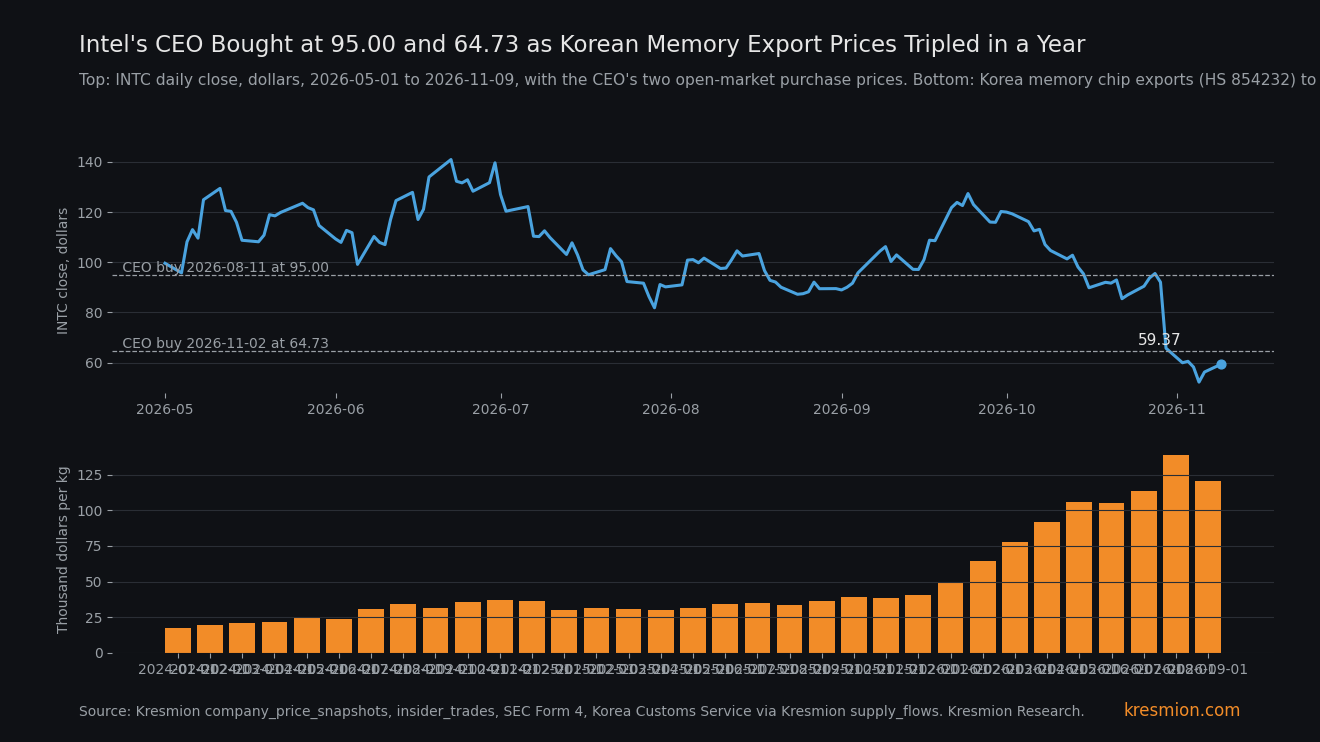
Intel's chief executive bought 9.7 million dollars of stock on the Monday after a 28.6 percent one-day fall, at a price 32 percent below his August purchase. Lip-Bu Tan bought 150,000 shares on November 2 at a weighted average of 64.7312, or 9,709,680 dollars, on the open market and outside a 10b5-1 plan (SEC Form 4). Intel (INTC) had closed at 65.76 on Friday, October 30, down 28.58 percent from 92.07, the worst of 2,485 daily returns in our price table. Intel guided client revenue down more than 20 percent and, per Beinsure, ties a PC recovery to memory supply, and Korean customs data shows memory export values per kilogram at their two highest readings in 81 months. We make no forecast: the data cannot say whether CEO purchases after crashes precede any price path.
Key takeaways
| What | Number |
|---|---|
| The fall, October 30 | INTC 92.07 to 65.76, -28.58 percent, rank 1 (worst) of 2,485 daily returns from December 20, 2016 to November 9, 2026. The previous worst was -26.06 percent on August 2, 2024. Volume 455.6 million shares, 4.6 times the 20-session average of 98.4 million (Kresmion company_price_snapshots) |
| The purchase, November 2 | 150,000 shares at a weighted 64.7312, 9,709,680 dollars, code P, not a 10b5-1 plan. His only other open-market purchase in our table (our insider table is dense only from August 2026): 105,263 shares at 95.00 (9,999,985 dollars) on August 11, 2026 (SEC Form 4, Kresmion insider_trades) |
| Where Intel is now | 59.37 on November 9. The August lot is 37.5 percent under water and the November lot 8.3 percent. On November 5, a day the S&P 500 fell 4.36 percent, the close was 52.25, 19.3 percent below his November price (Kresmion) |
| Intel's guidance and stated memory link | Fourth-quarter revenue guided to 15 to 16 billion dollars against about 17.07 billion consensus, adjusted EPS 0.25 against 0.43, client (PC) revenue down more than 20 percent from the third quarter (Beinsure, relaying Intel) |
| Memory prices | Korean memory exports (HS 854232) to China, Taiwan and the US: 120,241 dollars per kg in September 2026 against 36,647 a year earlier, 3.28 times, with weight up only 13.8 percent (Korea Customs Service via Kresmion supply_flows) |
| Size | 0.0028 percent of shares outstanding, but an 11.4 percent increase in his family-trust holding (Form 4, Kresmion company_shares) |
| Base rate | 35 of 443 CEO open-market purchase days since July 24, 2026 came on or within 7 days after a one-day drop of 20 percent or more. Intel's is the largest of the 35 (Kresmion) |
What the data shows
Intel closed at 92.07 on October 29 and 65.76 on October 30. That is a loss of about 139.8 billion dollars of market value, from about 489.4 billion to 349.5 billion on 5.315 billion shares outstanding as of October 23 (Kresmion company_shares, SEC frames). Volume was 455,599,400 shares against a 20-session average of 98,370,530, 4.6 times. Beinsure calls it the steepest one-day fall since 1974. We did not verify that against Intel's full listing history; our table covers about ten years.
The stock then closed at 59.97 (November 2), 60.55 (November 3), 58.27 (November 4), 52.25 (November 5), 56.28 (November 6) and 59.37 (November 9). Intel ended 2025 at 36.90, reached 140.94 on June 22, 2026 (3.82 times year-end) and was already 34.7 percent below that high at 92.07 before the report. At 59.37 it is 57.9 percent below it.
Intel's guidance, as relayed by Beinsure: fourth-quarter revenue of 15 to 16 billion dollars, adjusted EPS of 0.25, adjusted gross margin of 38 percent against 44.1 percent in the third quarter, and client revenue down more than 20 percent sequentially. Beinsure reports that Intel expects industry PC units down about 12 percent in 2026 and about 10 percent in 2027 and does not expect a sustained recovery until memory availability improves and prices normalize. The page's statement that memory costs are making PCs dearer is Beinsure's own wording. Intel also cited an accident at Kiryat Gat that cuts fourth-quarter revenue by about 300 million dollars and gross margin by about 2 points. Bank of America moved to Neutral with a target of 100 from 145; Goldman cut to 100 from 150, Bernstein to 75 from 110, Morgan Stanley to 75 from 84.
The third quarter itself was strong: revenue 16.5 billion dollars (+21 percent), Data Center and AI 7.3 billion (+78 percent), Client Computing 8.1 billion (-5 percent), adjusted EPS 0.52.
The Form 4, made public on November 4, shows the family trust holding 1,464,669 shares after the trade (up from 1,314,669, +11.4 percent), 16,471 shares directly and 500 in a 401(k): 1,481,640 common shares in total, about 87.96 million dollars at the November 9 close. No derivative holdings appear on this form.
The mechanism
In Beinsure's account, AI data center build-out pulls memory makers toward high-bandwidth memory, which tightens supply, raises prices of conventional memory and makes PCs dearer. If that holds, Intel's client unit, 8.1 of 16.5 billion dollars of third-quarter revenue, is the part exposed to it. Our Korean customs series sees the input-cost side independently of Intel. Korean memory export value per kilogram was 120,241 dollars in September, 3.28 times the 36,647 of a year earlier, while weight shipped rose only 13.8 percent. Total value rose 3.74 times, from 5.91 to 22.06 billion dollars, on 183,504 kg against 161,194 kg. The value surge is therefore price or product mix. August (138,706) and September are the two highest of 81 months since January 2020. US memory imports under the same code were 1.257 billion dollars in September against 154.6 million a year earlier (US Census via Kresmion).
The market treated it as chip and PC news too. On October 30 AMD fell 10.88 percent, Qualcomm 11.12, Dell 10.77, HP Inc (HPQ) 9.58 and Arm 9.97, against TSMC at 5.95, Micron 5.30, Nvidia 4.22, Texas Instruments 3.87 and Apple 1.23. The S&P 500 fell 1.82 percent, the Nasdaq Composite 2.86 and the XLK technology fund 4.89. These are context only: we did not check each company's own news, and price data does not show what drove any of them.
The second-order point is that the AI demand that lifted Intel's data center revenue 78 percent is the same force that Beinsure's account links to Intel's PC outlook. The CEO's purchase is then in effect a position on memory supply easing, a variable that Korean and other memory makers set and Intel does not. That makes it checkable against a monthly public series rather than against Intel's own statements. We cannot split the guidance cut between memory costs and Intel's other problems.
Other explanations
Valuation unwind. The shares had risen 3.82 times from the end of 2025 to June. AMD, Qualcomm, Dell, HP Inc and Arm fell about 10 percent on average while Intel fell 28.6, so a large part of the move was specific to Intel. We did not test positioning.
Intel's own problems. Kiryat Gat, a Foundry operating loss of about 1.85 billion dollars and external foundry revenue of only 411 million in the third quarter are not memory-price items on their face.
Market-wide risk-off. The S&P 500 and Nasdaq fell that day, but we did not estimate how much of a 28.6 percent drop that explains.
For the purchase itself there are three readings: a signal or reputational support after a historic drop, averaging down a position already 31.9 percent under water, or private information about the data center or foundry business. Nothing we hold separates these three readings.
The base rate
Price: the 28.58 percent fall ranks first of 2,485 daily returns, December 20, 2016 to November 9, 2026, on a daily standard deviation of 3.01 percent, about 9.5 standard deviations. Third worst was -18.04 percent on March 16, 2020. Some trading days may be missing, and this is our ten-year window.
Insiders: our CEO-tagged purchase rows start on July 24, 2026. From then to November 9 there were 443 CEO open-market purchase ticker-days outside 10b5-1 plans, and 35 came on or within 7 calendar days after a one-day drop of 20 percent or more in the same stock. Intel's 9.71 million dollars is the largest of the 35 (next: CDNL 3.20 million, ONON 1.99 million, NXH 1.00 million). Intel's two purchases are among 18 CEO ticker-days of 5 million dollars or more in the window. Fifteen weeks give no basis for saying what follows such purchases, and we ran no forward-return test.
Memory: August and September 2026 are the two highest of 81 monthly readings since January 2020.
Search space: five desks filed 15 findings, and one desk scanned about 3,336 purchases and gamma for more than 50 tickers before surfacing Intel, so the rank 1 framing was chosen after the fact. We ran about six tests ourselves. Our CEO filter includes "Chief Executive" labels; a filter on "CEO" alone missed 249 purchase rows.
The evidence against
His purchases have not marked a floor. The August lot at 95.00 was 31.9 percent under water when he bought again, and on November 5, three sessions after the November buy, Intel closed at 52.25, 19.3 percent below his price. That session was market-wide: the S&P 500 fell 4.36 percent, the Nasdaq Composite 5.52 percent and XLK 8.0 percent, and Intel fell 10.3 percent.
The memory link is weaker in the latest month. Value per kilogram fell 13.3 percent from August to September while weight shipped jumped 34 percent, the opposite of an intensifying squeeze, though value per kilogram is a price proxy that also moves with product mix. Intel fell 28.6 percent on October 30, nearly three times the 10.5 percent average of AMD, Qualcomm, Dell, HP Inc and Arm, and by more than that against TSMC, Micron, Nvidia, Texas Instruments and Apple, which points to Intel-specific causes for most of the move. The guidance reaches us through one press page, and the Korean data covers memory export values only, not PC builds. The purchase is also tiny against the company, 0.0028 percent of shares outstanding and 0.007 percent of the value lost on October 30, though material for him on the holdings this Form 4 shows.
What would change the read
Our Korea Customs loads have arrived around the 15th of the following month, so October data should load after November 15. October value per kilogram back toward the 2025 range of about 34,000 to 40,000 dollars would ease the memory cost behind Intel's PC outlook, and a reading above August's 138,706 would deepen it. Any further Form 4 from Tan must be filed within two business days of a trade. Intel closes relative to 64.73 and 52.25 show whether the November price holds. Applied Materials reports after the close on Thursday, November 12, with memory equipment demand in focus (heygotrade calendar). We have not confirmed the date of Intel's next quarterly guidance. US October CPI is due today at 8:30 ET, with consensus of 0.3 percent headline and 0.2 percent core (FXEmpire via heygotrade). Intel closed at 59.37 on November 9.
Frequently asked questions
How unusual was Intel's fall?
The 28.58 percent drop on October 30 is the worst of 2,485 daily returns in our table from December 20, 2016 to November 9, 2026. The previous worst was 26.06 percent on August 2, 2024. Beinsure's claim of the steepest fall since 1974 is not something we verified.
What did Intel's CEO buy and at what price?
On November 2 he bought 150,000 shares at a weighted 64.7312, 9,709,680 dollars, on the open market and not under a 10b5-1 plan. On August 11 he bought 105,263 shares at 95.00, 9,999,985 dollars. Both are the only two such purchases in our table, which is dense only from August 2026, so they may not be his only buys.
Is the CEO's purchase a signal?
Of 35 CEO buys since July 24 that came on or within 7 days after a one-day drop of 20 percent or more, his is the largest. The window is 15 weeks and we ran no forward-return test, so we offer no read on what follows. His August purchase is 37.5 percent under water.
Why would AI demand hurt a PC chip maker?
Beinsure reports that Intel ties a PC recovery to memory availability and prices; the page's line that memory costs make PCs dearer is Beinsure's own wording. Korean memory export value per kilogram tripled year on year in September on only 13.8 percent more weight, which fits higher memory prices, with the caveat that it is sensitive to product mix.
What is the next data point?
Korea's October memory export data around November 15, any new Form 4 from Tan, and Applied Materials' report after the close on November 12.
Sources
SEC Form 4, Intel Corp, reporting owner Tan Lip-Bu: 150,000 shares bought November 2, 2026 at 64.7312, code P, not 10b5-1, post-trade holdings.
Beinsure, Intel shares plunge 29% as investment banks slash targets after Q3 earnings: guidance versus consensus, Q3 segments, memory and PC outlook, Kiryat Gat, analyst target changes, the 1974 claim.
heygotrade, Weekly economic outlook, November 9 to 13, 2026: CPI consensus, Applied Materials date and the week's calendar.
Kresmion research page, Intel: company_price_snapshots, insider_trades and company_shares, queried directly.
Kresmion commodities page: Korea Customs Service memory exports (HS 854232) and US Census imports, from supply_flows, queried directly.
Kresmion research page, Nvidia: options_gamma_exposure, used in our follow-up post and not in this note's analysis.