By Kresmion Research, October 16, 2026
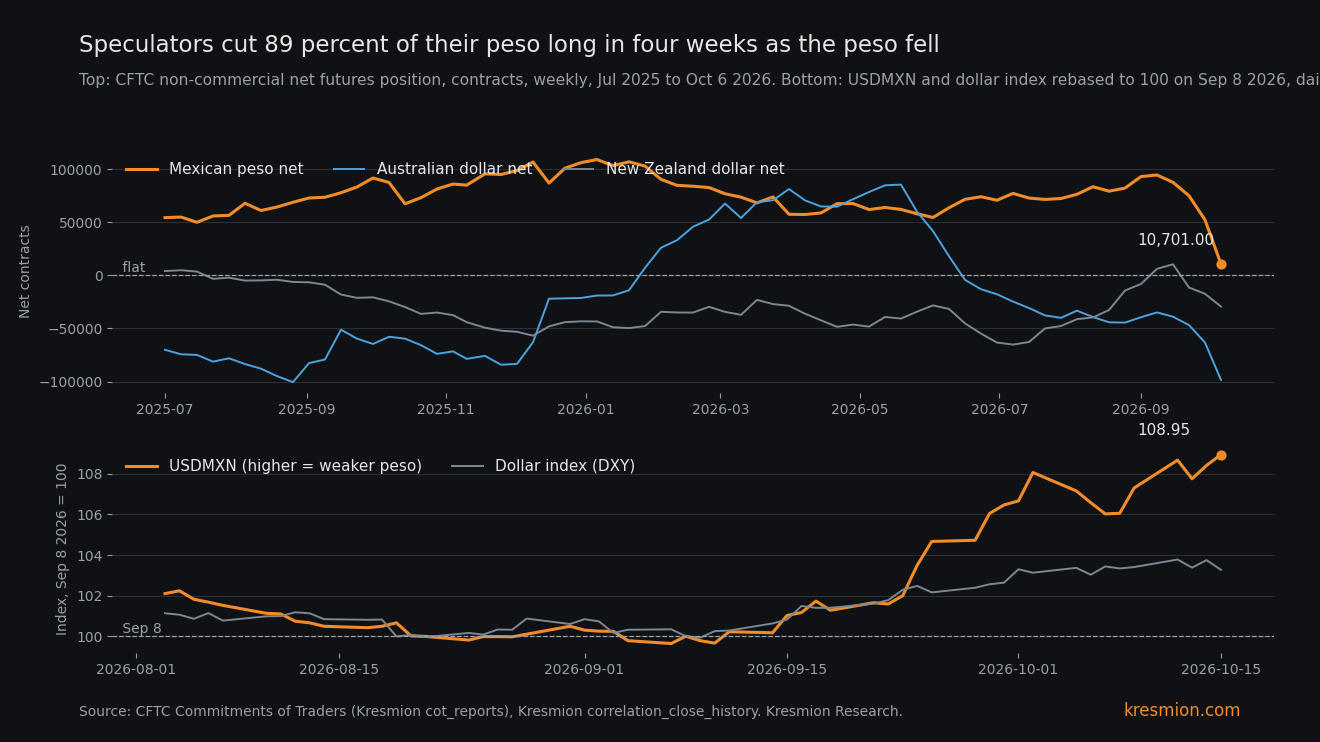
Speculators cut their Mexican peso futures long by 84,031 contracts in four weeks to October 6, or 88.7 percent of the position, as the rate gap narrowed. The figures come from the CFTC report for Tuesday October 6, the latest loaded in Kresmion's cot_reports table. The report for October 13 is not loaded yet, so the data are 10 days old. The non-commercial net long (the CFTC group usually called speculators) fell from 94,732 contracts on September 8 to 10,701, and gross longs fell 71,101 while gross shorts rose 12,930, a split distorted by the September contract roll. Most of the cut came in the two reports after Banxico held at 6.50 percent on September 24 and dropped its hold guidance, following the Fed's September 16 hike to 3.75 to 4.00 percent. The hike narrowed the rate gap by 0.25 points, from 2.75 to 3.00 points to 2.50 to 2.75. The claim rests on speed alone: the net is still long. Position and price describe one market, so they count as one observation.
Key takeaways
| What | Number |
|---|---|
| Net long, September 8 to October 6 | 94,732 to 10,701 contracts. The cut of 84,031 is 88.7% of the September 8 net long and 28.9% of open interest of 290,507 (cot_reports, MXN/USD) |
| Composition | Longs 169,798 to 98,697 (-71,101), shorts 75,066 to 87,996 (+12,930). Both fell in the September 15 roll week (longs -35,191, shorts -28,241, net -6,950). From September 15 to October 6: longs -35,910, shorts +41,171 |
| Last two weeks | -22,765 (September 29) and -41,701 (October 6). The weekly -41,701 ranks 5 of 326 weekly changes since July 2020 |
| Price, September 8 to October 6 | USDMXN 16.9098 to 17.9692 (+6.26%). Dollar index (DXY) 98.84 to 101.83 (+3.03%). FX rows in correlation_close_history are stamped a day after their session, so each USDMXN close is read from the next row |
| Level | Net is 3.68% of open interest. 103 of 327 weeks since July 2020, including this one, were at or below it. The prior 52-week average was 35.7% |
| Policy gap | Fed range 3.75 to 4.00 (September 16), Banxico 6.50 (held September 24). Gap 2.50 to 2.75 points, down from 2.75 to 3.00 (Fed range 3.50 to 3.75 before September 17) |
| Breadth | Four or more of 7 dollar pairs in their own bottom 5% of weekly changes: 2 of 326 weeks, one of them October 6, 2026 |
What the data shows
The peso net long was 94,732 contracts on September 8, then 87,782 on September 15, 75,167 on September 22, 52,402 on September 29 and 10,701 on October 6. Over the four weeks gross longs fell from 169,798 to 98,697, a drop of 71,101, while gross shorts rose from 75,066 to 87,996, a rise of 12,930. Open interest, the total number of contracts outstanding, was 327,215 on September 8 and 290,507 on October 6. Measured against the October 6 figure, the 84,031 cut equals 28.9 percent of the market.
The price moved further than the dollar did. From September 8 to October 6 USDMXN (pesos per dollar, so higher means a weaker peso) rose 6.26 percent, from 16.9098 to 17.9692, while the dollar index rose 3.03 percent. Each USDMXN close is read from the next row of correlation_close_history, because FX rows in that table are stamped one weekday after their session. USDMXN rose 1.48 percent on September 23, the day before Banxico's decision, 1.13 percent on decision day, September 24, and 0.06 percent on September 25. The dollar index moved +0.50, +0.19 and -0.32 percent on those days. Of 1,243 weekday changes since 2022, 66 were at or above 1.13 percent. In the COT week to October 6, the largest cut, USDMXN slipped 0.41 percent, from 18.0436 to 17.9692.
The peso has kept weakening since the positioning date. On October 8 Banxico published the minutes of its September meeting, in which three of five board members left room for cuts, and the peso fell about 1.2 percent that day (Rio Times). USDMXN closed at 18.3739 on October 13 and 18.4637 on October 14, which is +8.66 percent and +9.19 percent from September 8. The live USDMXN quote was 18.409 at 05:19 UTC today, -0.30 percent on the day and +1.22 percent on the week. We do not have positions after October 6, so we cannot say what speculators did during that extra move.
The mechanism
A long peso position in futures earns the gap between Mexican and US short-term interest rates, which traders call carry. The Fed raised its range by a quarter point to 3.75 to 4.00 percent on September 16 (Kresmion fred_series_history, DFEDTARL and DFEDTARU, and Rio Times). Banxico held at 6.50 percent on September 24, a third straight hold since a cut on May 7, with the balance of inflation risks tilted up and slack expected (Trading Economics). The gap is now 2.50 to 2.75 points, down from 2.75 to 3.00 points before the hike, when the Fed range was 3.50 to 3.75 percent (fred_series_history). That is a narrowing of 0.25 points, about 9 percent of the gap, against an 88.7 percent cut in the net position.
Banxico also dropped its line about keeping the rate at its current level, which Bloomberg read as opening the door to cuts, according to Rio Times. On September 29 Governor Rodriguez Ceja said Mexico need not copy the Fed. A narrower gap and a central bank leaning toward cuts both shrink the reward for holding the position. The timing is loose: the largest peso day came the day before the decision, the day after the decision was nearly flat, and the biggest position cut came in a week when USDMXN was slightly lower. Speculators cut 22,765 and 41,701 contracts in the next two weekly reports.
The second-order point is open. The four-week split straddles the September roll, when both gross sides fell. After the roll, from September 15 to October 6, gross shorts rose 41,171 and gross longs fell 35,910. In the week to October 6 shorts rose 24,967 against 16,734 of long closing. New shorts were as large a part of the move as long closing, so these data do not show whether the pool of longs that can be forced out is nearly used up. The next COT report shows the split.
Other explanations
A broad dollar bid, with no carry story. The dollar index rose 3.03 percent over the same span and the peso fell more than twice as far, but part of the move is general. AUD/USD fell 3.30 percent and EUR/USD fell 3.22 percent from September 8 to October 6 (closes read from the next row). Euro speculators also sold in the week of October 6 (net change -36,076, percentile 0.012 of its own history), and the euro yields less than the dollar, so carry cannot explain that selling.
Price-led exits. The peso fell first, on September 23 and 24, and positions were cut afterwards, so trend followers being stopped out fits the sequence as well as a deliberate rethink of carry. A weekly report cannot order events inside a week, so the two cannot be separated.
A quarterly expiry artifact. This is rejected for the net position but not for the gross legs. The September expiry fell in the September 15 report week, the two large cuts came on September 29 and October 6, and open interest rose in the final week, from 274,821 to 290,507. The roll does distort the gross legs in the September 15 week, when longs fell 35,191 and shorts fell 28,241 with the net down only 6,950, and open interest fell from 327,215 on September 8 to 266,061 on September 22. The four larger weekly cuts in the table all landed on quarterly-expiry weeks.
Hedge reclassification. The non-commercial group is a legacy bucket that mixes funds with other large traders, and some longs may be hedges of Mexican assets that were unwound for unrelated reasons. Magnitude unknown.
The base rate
The window is July 7, 2020 to October 6, 2026, 327 weekly reports in cot_reports. The weekly change of -41,701 ranks 5 of 326; the four larger are -99,460 (December 20, 2022), -68,739 (June 18, 2024), -63,593 (March 15, 2022) and -59,107 (June 14, 2022). The four-week change of -84,031 ranks 5 of 323, but the four larger values are overlapping windows ending between December 20, 2022 and January 10, 2023, one episode. It is the second largest distinct episode in the table.
The table starts in 2020, so we checked the CFTC history file (contract 095741). March 2020 was larger: the net long went from 131,181 on March 3 to 7,665 on March 31, a cut of 123,516. Four-week changes before 2020 were not computed, so the size against 2008 or 2016 is unknown and we make no record claim.
The level is ordinary. A net of 3.68 percent of open interest has 103 of 327 weeks, including this one, at or below it, the 31st percentile, with a minimum of -32.0 percent. The prior 52-week average, October 7, 2025 to September 29, 2026, was 35.7 percent, so the position has moved from a crowded long to a small one.
For breadth, the weekly net changes in AUD, NZD and MXN all sat in their own bottom 5 percent in 1 of 326 weeks, October 6. That test chose its three currencies after we saw the data, so the count describes the week and is not a p-value. The less tailored version looks at seven dollar pairs (AUD, NZD, MXN, EUR, CAD, BRL, GBP): four or more were in their own bottom 5 percent in 2 of 326 weeks, July 30, 2024 and October 6, 2026. Selection also matters at the front end. We screened 19 to 20 non-crypto COT markets, 14 of them by 53-week z-score, and about 60 cross-asset comparisons, and MXN was picked as the largest absolute z. That inflates any single percentile, which is why the base rates above come from full-table distributions with no filter on the measured value.
The evidence against
The strongest point against a carry-specific story is the euro. In the same week euro speculators sold almost as hard as peso speculators, and a general dollar bid explains both. AUD, NZD, MXN and EUR share one US rate and dollar factor, so their moves do not confirm each other. AUD net went from -34,870 to -98,588 between September 8 and October 6, and the gross short of 198,726 is the largest in cot_reports since July 2020. As a share of open interest of 328,682 it is 60.5 percent, which 38 weeks since 2020 exceeded, and open interest jumped around the September roll, so that share is a distorted measure. NZD net went from +6,232 to -29,346. Speculators in dollar index futures barely changed, 11,881 to 12,011 in the October 6 week, though that contract is a thin view of the dollar.
The net peso position is still long, at +10,701, and the level is ordinary, so the claim rests on speed alone. The larger cuts in March 2020 and December 2022 show that moves this size happen in this contract a few times a decade. Position and price are also one market, so the USDMXN rise is not a second confirmation of the position data. The only independent leg is the policy record, the Banxico statement and the governor's remarks. It explains timing. It does not explain size. The central_bank_rates table holds only one month of history, so how much the gap narrowed over time is unknown beyond the September 16 hike.
What would change the read
The CFTC report for Tuesday October 13 is not in cot_reports yet. The CFTC normally publishes on Friday, which is today. If the peso net is back above 52,402, the September 29 level, the unwind was a two-week flush. If shorts jump well above 87,996 while longs hold, new bets are replacing liquidation. If USDMXN closes back below 18.04, the September 29 close, while the dollar index stays near 102, the peso-specific part of the move is gone. If AUD, NZD and EUR selling reverses next week and MXN does not, the dollar-factor explanation weakens.
Banxico's September minutes, published October 8, are an observed event after the positioning date: three of five board members left room for cuts and the peso fell about 1.2 percent that day. Only the October 13 and later reports show what speculators did afterwards.
The Fed meets on October 27 and 28 and Banxico decides on November 5. Another Fed hike or a Banxico cut would narrow the 2.50 to 2.75 point gap further, and a Banxico hold with restored guidance would widen the case against this read. USDMXN closed at 18.4637 on October 14.
Frequently asked questions
Have speculators left the peso?
No. The non-commercial net is still long at 10,701 contracts on October 6, 3.7 percent of open interest, after 94,732 on September 8. Gross longs of 98,697 remain larger than gross shorts of 87,996.
Is this a record cut?
Not in the data we checked. In cot_reports the four-week cut is the second largest distinct episode since July 2020. March 2020 was larger in the CFTC history file (-123,516), and four-week changes before 2020 were not computed, so the comparison with earlier years is unknown.
Why would a narrower rate gap matter for a futures position?
A peso long earns the gap between Mexican and US short-term rates. When the Fed raises rates and Banxico holds and drops its hold guidance, the gap narrows to 2.50 to 2.75 points and the reward for holding the position falls. Futures data cannot show why traders acted, so this is a candidate channel.
Could this just be a stronger dollar?
Partly. The dollar index rose 3.03 percent against 6.26 percent for USDMXN, and euro speculators also sold in the same week, which carry cannot explain. USDMXN also rose more than the dollar index on several days in the window, including September 23, the day before Banxico's decision (+1.48 against +0.50 percent), and October 8, the day the minutes came out (+1.18 against -0.10 percent). That points to something peso-specific as well, but the data cannot separate the two.
When do we learn more?
The CFTC report for October 13 normally comes out today, October 16, and it will show whether longs kept closing or new shorts appeared. The Fed meets October 27 and 28 and Banxico decides on November 5.
Sources
Rio Times, Banxico Governor Says Mexico Need Not Follow the Fed With Rates at 6.5%, September 30, 2026: Fed hike to 3.75 to 4.00 on September 16, Banxico hold at 6.50 on September 24, dropped hold guidance, governor remarks on September 29, meeting dates.
Trading Economics, Banxico Holds Key Rate at 6.50% in September, September 24, 2026: rate unchanged at 6.50 percent, inflation risks tilted up, slack expected.
Rio Times, Mexican peso and the Banxico minutes, October 12, 2026: Banxico September minutes published October 8, three of five board members left room for cuts, peso fell about 1.2 percent that day.
Kresmion Research, cot_reports (CFTC Commitments of Traders), report dates July 7, 2020 to October 6, 2026: MXN/USD, AUD/USD, NZD/USD, EUR/USD and USD INDEX non-commercial positions and open interest.
Kresmion Research, cftc_history, contracts 095741 and 232741: March 2020 peso four-week cut and AUD and NZD positions.
Kresmion Research, correlation_close_history, USDMXN, DXY, AUDUSD, EURUSD: daily rows to October 15, 2026; FX pair rows are stamped one weekday after their session, so closes are read from the next row. Rows stamped October 16 are excluded because the EURUSD row is a stale copy of October 6.
Kresmion Research, fred_series_history (DFEDTARL, DFEDTARU) and central_bank_rates: Fed target range 3.75 to 4.00 on October 15, Banxico rate 6.50 percent for October 2026.
Kresmion Research, forex_rates, USDMXN=X: live quote 18.409 at 05:19 UTC on October 16, 2026.