
By Kresmion Research, November 5, 2026
Five Big Tech platform owners rose 4.55 percent on average on Wednesday while six data center suppliers fell 12.80 percent, the second widest gap since 2018. The session followed the election of Democrat Gina Hinojosa as Texas governor on a pledge to halt new data center construction. The gap of 17.35 percentage points ranks second of 1,966 sessions since December 18, 2018 in our company_price_snapshots table, and only January 27, 2025, the DeepSeek selloff, was wider. We chose the baskets after seeing the day, and our data cannot show that the election caused the move.
Key takeaways
| What | Number |
|---|---|
| Basket returns, November 4 | Platforms (AAPL, MSFT, AMZN, GOOGL, META) +4.55%, suppliers (VST, NRG, VRT, PWR, ETN, FIX) -12.80%, equal weight (company_price_snapshots) |
| The gap | 17.35 points, 2nd of 1,966 sessions since 2018-12-18. The widest was 21.63 on 2025-01-27. Median gap -0.05, standard deviation 2.05 |
| Single names | Each of the six suppliers had its 3rd to 8th worst day in its own history (PWR 3rd of 2,482). CEG was 20th of 972 |
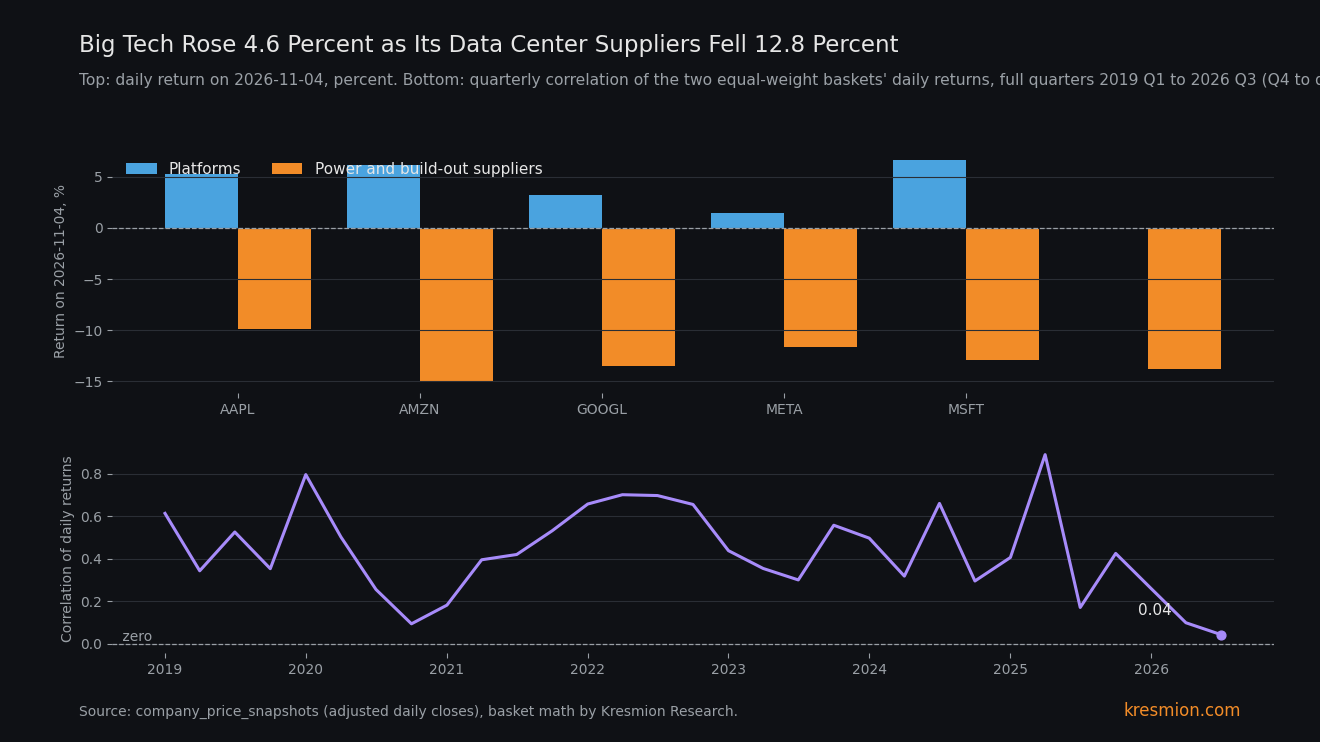
| Correlation of the two baskets' daily returns | 0.35 to 0.68 in every year 2019 to 2025. 0.172 in 2026 before Wednesday (211 sessions). Q3 2026 at 0.042, the lowest of 31 full quarters |
| Utilities | 25 electric and multi-utility names (industries Electric Utilities and Multi-Utilities, excluding VST and CEG) had a median +1.63% and 19 of 25 rose (NEE +4.89%, DUK +2.43%, SO -0.67%). Yields fell about 6 bp that day (CappNotes). Merchant generators VST -13.83% and NRG -13.52%, CEG -6.71% |
| Hedges | Baskets picked after seeing the day. Correlation over the 24 sessions from 2026-10-01 to 2026-11-03 was 0.584. VRT and ETN, headquartered outside Texas, fell 12.89% and 9.86%, against 13.83% for VST |
What the data shows
On Wednesday, November 4, the equal-weight platform basket (AAPL, MSFT, AMZN, GOOGL, META) rose 4.55 percent. The equal-weight supplier basket (VST, NRG, VRT, PWR, ETN, FIX) fell 12.80 percent. Every price figure in this note comes from Kresmion's company_price_snapshots joined to companies, close over prior close, queried November 5.
Among platforms, MSFT rose 6.68 percent (520.99 to 555.80), AMZN 6.12, AAPL 5.31 (331.90 to 349.51), GOOGL 3.18 and META 1.44. Among suppliers, FIX fell 15.08 percent, VST 13.83 (139.59 to 120.29), NRG 13.52, VRT 12.89, PWR 11.65 and ETN 9.86. Outside the baskets, GEV fell 9.30 percent (918.20 to 832.83), TLN 8.54 and CEG 6.71.
Against each name's own history the moves are large. Before Wednesday the standard deviation of daily returns was 2.90 percent for VST, 2.49 for NRG and 2.76 for FIX, against 1.73 for MSFT and 1.84 for AAPL. Each of the six suppliers had its 3rd to 8th worst day in our data: PWR 3rd of 2,482, FIX 5th of 2,482, VST 5th of 1,981, NRG 6th of 2,482, ETN 7th of 2,482 and VRT 8th of 1,981. CEG was 20th of 972. MSFT's gain was its 15th best of 2,611, AAPL's 21st of 2,536 and AMZN's 24th of 2,467.
The broad market did not fall. Index levels come from one fetched secondary source, CappNotes: the S&P 500 rose 1.58 percent to 7,688.62, the Dow 3.03 percent to 53,356.12 and the Nasdaq-100 0.91 percent to 28,437.17, with Technology -0.01 percent and Energy -4.74 percent. Our tables hold no November 4 index or sector fund closes. In our own universe, 4,176 names rose and 2,111 fell out of 6,498 with a row for the day (7,759 had a row on November 3, so the November 4 load is partial). The median return was +1.35 percent.
The trigger is reported on three pages. AP called the race at 11:17 p.m. ET on November 3 (Yahoo Finance). Hinojosa won by about seven points and is the first Democrat elected Texas governor since 1990 (Investing.com). She called for a data center moratorium lasting until the Texas Legislature meets in January, and Governor Abbott already had a freeze on environmental permitting and grid connections for data centers during an audit due to finish this year (Texas Tribune). These are three reports of one event. They do not show that the event moved prices.
The mechanism
Data center construction is spending for the platform owners and revenue for the companies that power, cool and wire the buildings. Texas holds more than 25 percent of planned US data center capacity by 2030 (Yahoo Finance), and about 27 percent of US data center gigawatts per Wells Fargo (via CappNotes). A pledge to halt new approvals there cuts the order book and power demand that suppliers can count on. It does nothing to the platforms' existing revenue, and it may cap capex they would otherwise spend. That last link is our hypothesis. We have not tested capex guidance or free cash flow.
Utilities mostly rose: in our table, 25 names tagged Electric Utilities or Multi-Utilities, excluding VST and CEG, had a median return of +1.63 percent on November 4 and 19 of 25 rose (NEE +4.89, DUK +2.43, SO -0.67). The tags are the table's own, and we have not verified which of these names are rate-regulated. Yields fell about 6 bp that day (CappNotes), so the utility rise fits a rate move as well as a demand split. Merchant generators priced on data center demand fell most: VST -13.83 and NRG -13.52, against CEG -6.71. KeyBanc cut Vistra from Overweight to Sector Weight on November 4 and named it the most exposed of the companies it covers, and Investing.com reports it as more exposed than Constellation.
The second-order implication concerns how the market has priced the build-out. Through 2026 before Wednesday the two baskets moved together less than in any earlier year (correlation 0.172, against 0.35 to 0.68), though still positively. One reading is that capex is a cost to the platforms and revenue to the suppliers, so a threat to the build-out can lift one side and hit the other. A second is that the platforms rose with a market-wide relief move (S&P 500 +1.58 percent per CappNotes) and the supplier fall is a separate event. Each reading is consistent with the moves. An index that holds mostly platforms can rise while the build-out chain falls hard. On a 1.58 percent S&P 500 day, the index level said little about these names.
Other explanations
Election de-risking and crowding. With the election over, money may have rotated out of crowded AI infrastructure winners into broad cyclicals. CappNotes reports breadth of about 3 to 1 and RSP, the equal-weight S&P 500 fund, up 1.86 percent against 0.91 for the Nasdaq-100. Under this reading the Texas pledge is a label on a positioning unwind. For it: VRT (headquartered in Ohio) and ETN (Ireland) fell 12.89 and 9.86 percent, against 13.83 for VST and 13.52 for NRG, and the correlation decay predates the election. PWR is headquartered in Houston, and we have no revenue split by state, so we cannot size Texas exposure. Against it: short interest at the 2026-10-15 settlement fell in five of six suppliers, but it predates the session by three weeks and cannot say who sold on November 4. Each reading is consistent with the moves.
Name-specific news. KeyBanc downgraded VST the same morning, and earnings season was under way. The downgrade can explain part of VST's move. It does not explain FIX, PWR and ETN falling 10 to 15 percent, or MSFT, AMZN and AAPL rising 5 to 7 percent.
Run-up and give-back. The supplier basket rose 5.09 percent on November 3, election day, and 2.88, 3.19 and 4.52 percent on October 26 to 28, so part of Wednesday's fall reverses earlier gains. We have not measured how much.
Oil and energy spillover. Independent power producers are sometimes traded with energy, and oil fell about 8 percent per CappNotes. XOM fell 4.62 percent and CVX 3.69, and power producers' revenue follows power and gas prices, with natural gas up 1.80 percent per CappNotes. The size of the oil move does not match the size of the producers' drop.
Platform-specific buying. A desk reading, which we did not re-run, put Apple's modeled dealer gamma at the lowest of 95 snapshots on November 3 (options_gamma_exposure). Negative gamma can amplify a move. That could explain part of AAPL's +5.31 percent and none of the supplier side.
The base rate
Window: 1,966 sessions from 2018-12-18 to 2026-11-04 in which all 11 names have a return, using adjusted closes. No daily move in the window exceeds 40 percent, so splits are not distorting the data. The 17.35 point gap is 2nd of 1,966. The widest was 2025-01-27 at 21.63, with platforms -0.20 and suppliers -21.83. That is the DeepSeek day, when Vistra closed nearly 30 percent lower and Constellation, Talen and GE Vernova each fell more than 20 percent (Transition Economics Institute). The 3rd widest was 2023-02-02 at 8.92 and the 4th 2020-11-04 at 8.41.
Post-election sessions are mixed. On 2022-11-09 the gap was +0.84 (platforms -1.22, suppliers -2.06) and on 2024-11-06 it was -2.00 (platforms +1.90, suppliers +3.90). On 2020-11-04 it was +8.41 (platforms +5.93, suppliers -2.48), the same direction as Wednesday at about half the size. Sessions with platforms above +2 percent and suppliers below -3 percent number 5 of 1,966: 2020-06-09, 2026-06-26, 2026-07-01, 2026-08-28 and 2026-11-04. Four of the five are in 2026.
The correlation of the two baskets' daily returns was 0.466 in 2019, 0.596 in 2020, 0.353 in 2021, 0.678 in 2022, 0.417 in 2023, 0.456 in 2024 and 0.569 in 2025. For 2026 it was 0.172 excluding Wednesday (211 sessions) and 0.093 including it. By quarter, 2026 Q1 was 0.259, Q2 0.098 and Q3 0.042, the lowest of 31 full quarters since 2019 Q1. The previous low was 0.093 in 2020 Q4.
Three limits on these numbers. First, the price facts all come from one table, so the gap, the ranks and the correlations are one measurement, which no other source confirms. Second, our desks ran about 60 queries across five desks and 15 findings, and about 14 of them were for this angle. We built the baskets after seeing November 4, from about 14 candidate names. CEG, GEV and TLN were left out because their histories start between 2022 and 2024 and would shorten the window, and including CEG would also have shrunk the gap. Choosing the extreme day and the names after the fact inflates the rank. Single-name worst-day ranks are less sensitive to that choice and still put every basket supplier in its own bottom 10. Third, we tested one basket definition and one correlation frequency, so multiple-comparison risk is modest, though the correlation finding is still post hoc.
One check comes from outside the price table. FINRA short interest at the 2026-10-15 settlement, the latest in our short_interest table, showed VST at 9.95 million shares (2.98 percent of float, down 5.1 percent), NRG 5.98 million (2.85 percent, down 2.7), FIX 0.76 million (2.18 percent, down 10.9), VRT 13.96 million (3.63 percent, down 3.0) and ETN 7.52 million (1.94 percent, down 5.9). PWR was 3.46 million, up 8.2 percent. That settlement predates the election by three weeks and says nothing about who sold on November 4.
The evidence against
The 24 sessions before Wednesday cut against the decoupling story. Over the 24 sessions from 2026-10-01 to 2026-11-03, the two baskets' daily-return correlation was 0.584, close to the 2019 to 2025 norm. The negative Q4 reading, -0.037 over 25 sessions, comes entirely from Wednesday. The 2026 decay therefore rests on Q2 and Q3, and a single day cannot show that the market now prices the two sides as opposites.
The Texas channel also has a weak point. Abbott already had a permitting and grid-connection freeze in place during an audit, so the incremental effect of a moratorium until January is unclear. And VRT (headquartered in Ohio) and ETN (Ireland) fell 12.89 and 9.86 percent, against 13.83 for VST and 13.52 for NRG. That fits a general AI build-out de-rating as well as a Texas-specific one. The data cannot say how much of the 12.80 percent was Texas policy and how much was positioning.
What would change the read
1. Platform and supplier correlation over the next 20 sessions, through about 2026-12-03. A return to the 0.58 of the 24 sessions before Wednesday would make November 4 look like a one-day event and weaken the decoupling claim. A reading that stays low or turns negative would strengthen it. 2. Recovery pattern. If VST and NRG recover their losses while VRT and ETN, headquartered outside Texas, do not, the Texas channel weakens. The reverse pattern would support it. 3. FINRA short interest for the 2026-11-13 settlement, published about two weeks later, is the first reading after the event and will show whether shorts built in the suppliers. The 2026-10-30 settlement predates it. 4. Texas policy: whether Abbott's audit freeze ends this year as planned, and what the Legislature does when it meets in January. 5. The next platform capex guidance at Q4 results. A capex cut would support the cost-to-buyers reading.
On 2026-11-04 the platform basket rose 4.55 percent and the supplier basket fell 12.80 percent.
Frequently asked questions
How unusual was the gap between Big Tech and its suppliers?
The 17.35 point gap between the equal-weight baskets is 2nd of 1,966 sessions since 2018-12-18. Only 2025-01-27, the DeepSeek day, was wider at 21.63. The median gap is -0.05 and the standard deviation 2.05 points. We picked the baskets after seeing the day, which inflates the rank.
Did the Texas election cause the move?
Our data cannot show that. Three outlets report the election result and the moratorium pledge, and one reports a KeyBanc downgrade of Vistra. VRT (headquartered in Ohio) and ETN (Ireland) fell 12.89 and 9.86 percent, against 13.83 for VST and 13.52 for NRG, so a broader de-rating or a positioning unwind fits too.
Why would the same news lift Big Tech and hit suppliers?
Data center capex is a cost to the platform owners and revenue to the suppliers. A threat to the build-out can lower expected supplier orders while leaving the platforms' existing revenue untouched. That the platforms' spending may be capped is our hypothesis, and we have not tested capex guidance.
Are the two halves of the AI trade now moving separately?
In 2026 before Wednesday their daily-return correlation was 0.172, against 0.35 to 0.68 in every year 2019 to 2025, and Q3 at 0.042 was the lowest full quarter. The 24 sessions before Wednesday came in at 0.584, so one day does not settle it.
What is the next data point?
Short interest for the 2026-11-13 settlement, the first reading after the event, and the correlation over the next 20 sessions. On the macro calendar, October payrolls are due Friday 2026-11-06 at 8:30 ET, with a forecast of 40,000 after 29,000 and unemployment at 4.2 percent (RoboForex).
Sources
Texas Tribune, Under Hinojosa, Texas data center approvals could stay paused: moratorium pledge until the Legislature meets in January, and Abbott's existing freeze during an audit.
Yahoo Finance, A Democrat won the Texas governor's race after promising to halt new data center construction: Texas above 25 percent of planned US capacity by 2030, and the AP call time.
Investing.com, Vistra plunges 13.5% as Texas election rattles AI power trade, KeyBanc downgrades: KeyBanc downgrade of VST, the seven-point margin and Vistra's exposure against Constellation.
CappNotes, Closing Look, Wednesday November 4: index, sector, oil and gas moves for November 4 and the Wells Fargo 27 percent figure. A single secondary source.
Transition Economics Institute, DeepSeek Wipes Out a Year of AI Power Gains in a Day: January 27, 2025 power stock moves.
RoboForex, Jobs Report Friday: Midterm Elections and NFP Week: payrolls forecast for Friday November 6.