
By Kresmion Research, November 18, 2026
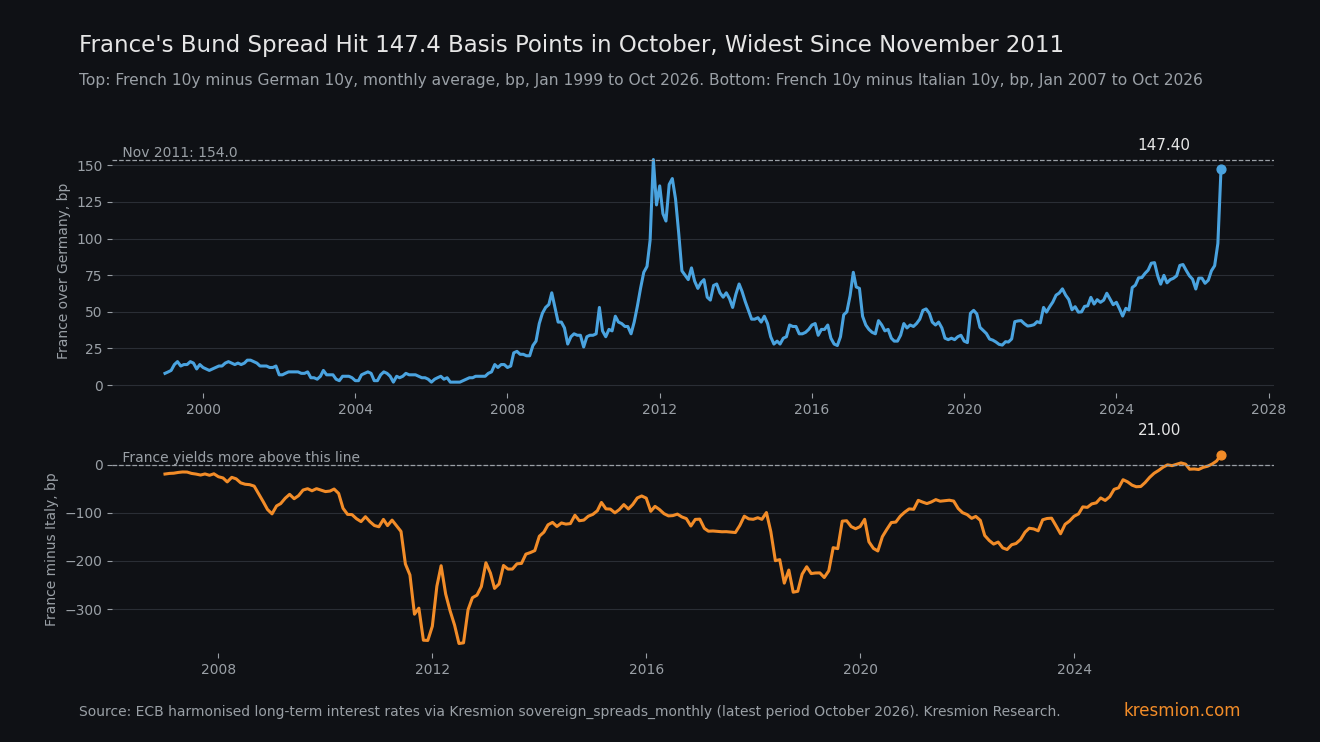
France's 10-year spread over Germany reached 147.4 basis points in October, the widest monthly average since November 2011, and France yields more than Italy. On the ECB's harmonised long-term rate series, France's 10-year averaged 4.89% against the Bund's 3.416%, and the spread rose 50.7 basis points in one month. France's 10-year has yielded more than Italy's in only 6 of 334 months, all since December 2025, and October's gap of 21.0 basis points is the widest. This is one data series. Italy's spread also widened sharply, a monthly average can hide a spike, and the France reading came out of a 41-country scan, so a multiple-comparison discount applies.
Key takeaways
| What | Number |
|---|---|
| France 10-year minus Germany 10-year, October 2026 | 147.4 bp, up 50.7 bp on September and up 65.1 bp on a year earlier (ECB harmonised series via Kresmion) |
| Rank in its own history | 2nd of 334 monthly observations since January 1999, 99.7th percentile. Only November 2011 (154.0) was wider (ECB via Kresmion) |
| One-month widening | +50.7 bp, 2nd largest in the series, behind November 2011 (+55.0) (ECB via Kresmion) |
| Cross-section of 41 countries | France is the highest relative to its own history (99.7th percentile). Italy's 126.4 bp sits at the 52.9th, Belgium's 96.4 bp at the 92.2nd, Spain's 65.0 bp at the 42.0th (ECB via Kresmion) |
| France minus Italy, October 2026 | +21.0 bp, the widest gap. France has yielded more than Italy in 6 of 334 months, all since December 2025 (ECB via Kresmion) |
| Live check, November 17 | France 4.898%, Italy 4.437%, Germany 3.381%: about 152 bp over Bunds and 46 bp over Italy (Trading Economics, our arithmetic, a different series) |
What the data shows
The series is the ECB's harmonised long-term interest rate for 10-year government bonds, stored in our sovereign_spreads_monthly table, last refreshed November 17. France's spread over the Bund ran 71.6 bp in June, 78.0 in July, 81.5 in August and 96.7 in September before jumping to 147.4 in October. The French 10-year yield rose 45.0 bp over the month while the German yield fell 5.7 bp, so about 45 of the 50.7 bp widening came from a higher French yield.
Italy's 10-year averaged 4.68% in October against France's 4.89%. France's yield was above Italy's in 6 of the 334 months in the table, the first being December 2025 at +0.8 bp. September 2026 was +7.8 bp and October +21.0 bp. For scale, the most negative reading was -371.6 bp in July 2012, and in November 2011 Italy yielded 364.7 bp more than France.
Live benchmark quotes show the gap still open (Trading Economics, France, Italy, Germany). On November 17 France's 10-year was 4.898%, Italy's 4.437% and Germany's 3.381%. That is 151.7 bp over Bunds and 46.1 bp over Italy by our arithmetic. These are over-the-counter benchmark quotes, a different series from the ECB monthly average. Both measure the same French and German bonds, so they are one confirmation at two timestamps.
The mechanism
One reading is a fiscal and political risk premium on France, against a backdrop of rising global yields. Bank of Singapore puts French debt to GDP as approaching 120% and notes the presidential election in April 2027 (Bank of Singapore). Trading Economics describes France as under fiscal pressure ahead of that election, and reports that on November 16 to 17 markets priced a December ECB hike and two more in 2027, with inflation at twice the 2% target, although most economists it cites expect the ECB to pause after December. We have no data on what was priced in October, and the 10-year Bund yield fell 5.7 bp that month, so a rate shock common to all euro bonds does not explain the French widening on its own. Italy and Belgium widened 37.5 and 31.7 bp, and we did not query their debt ratios.
Bank of Singapore estimates that foreign investors hold about 60% of French debt, and says unwinds and foreign selling may have amplified the move. That is a holder base that can push quickly in either direction.
The second-order point concerns the backstop. In 2011 France widened alongside Italy. Today the premium sits with France, and Italy's spread is at its historical median (52.9th percentile). The ECB's Transmission Protection Instrument can be activated against "unwarranted, disorderly market dynamics", and its eligibility criteria include compliance with the EU fiscal framework, meaning not under an excessive deficit procedure, or not assessed as failing to take effective action (ECB, 21 July 2022). As of the page we fetched, France has had an open procedure since the Council decision of 26 July 2024, with its latest report on action taken dated 7 May 2026 (European Commission). France's procedure does not by itself rule it out, since the criterion also accepts a country not assessed as having failed to take effective action, and Bank of Singapore expects the ECB's toolkit to limit crisis-level spreads. Whether the ECB would call this widening unwarranted is its call, and our data has no bearing on it. Holders of euro core government indices and collateral pools now carry a risk premium that, in this series, used to belong to the periphery.
Other explanations
Four alternatives compete with a France-specific reading.
Euro-wide repricing. In October Italy's spread widened 37.5 bp, Belgium's 31.7, Greece's 24.7 and Spain's 19.6, while the Netherlands (2.8) and Austria (6.0) barely moved. Much of the move looks like a general premium on non-core debt. France still widened the most, it is the only one of the 41 countries above the 99th percentile of its own history, and its yield minus Italy's widened 13.2 bp in the month, from 7.8 to 21.0.
Technical flow. If foreign selling and unwinds drove October, it could reverse with no change in fiscal fundamentals. We cannot see holder flows, so we cannot split the move between forced selling and a repricing of credit risk.
Global term premium. The US 10-year yield was 5.12% on November 16. A global move would lift Bunds as well, yet the Bund yield fell 5.7 bp in October, and the French spread is measured against Germany. The US spread over Bunds sits at the 74.2nd percentile of its own history.
Measurement. The ECB series is a monthly average of a harmonised convergence-criteria yield, not a month-end quote on the benchmark OAT. The November 17 over-the-counter quotes, about 152 bp over Bunds, are consistent with the October average.
The base rate
The window is France's spread to Bunds on this ECB series, monthly, January 1999 to October 2026, 334 observations. At 147.4 bp the reading ranks 2nd and sits at the 99.7th percentile. Only November 2011 (154.0) was wider, so this is not a record. May 2012 (141.0) and April 2012 (137.0) rank 3rd and 4th. The +50.7 bp month is the second largest one-month widening, after November 2011's +55.0, with April 2012 (+25.0) third.
Two cautions. Monthly levels overlap and are serially correlated, so the 334 points are not independent draws. And the cross-section scan covered 41 countries. If those countries were independent, the chance that at least one sits in the top two of its own history (the 99.7th percentile or higher) by luck would be about 22% (41 x 2/334 is about 25%). They are correlated, so the true figure is lower, but we cannot say by how much. What survives is that the reading is not marginal, at rank 2 of 334 and second only to the 2011 crisis peak, and that the France-over-Italy run was tested as a separate, directed question.
The euro slid from 1.1222 (EUR/USD close, November 10) to 1.0991 in the 05:15 UTC live quote on November 18, and the CFTC euro net short is large but not extreme (the sampled CFTC history shows 220,963 contracts on March 24, 2015 and 215,258 on April 7, 2015, and the sample is thin, so the true peak may be larger). Both may share drivers with this move, such as US rates and a stronger dollar (dollar index 101.65 on November 9, 103.62 on November 17), so we do not present them as independent confirmation.
The evidence against
The strongest point against a France-specific story is October's breadth. Italy's spread widened 37.5 bp, about three quarters of France's 50.7, and Belgium's widened 31.7 bp, taking it to the 92.2nd percentile of its own history. Only 13.2 bp of the move shows up in France against Italy.
There is no sign of a reversal in November. On the November 17 Trading Economics quotes France's 10-year yield is 3 bp lower than a month ago, but Germany's is 7 bp lower and Italy's 13 bp lower, so France's gap to both is wider than a month ago (about 152 bp over Bunds against the 147.4 October average, and 46 bp over Italy against 21.0). Bank of Singapore wrote on October 12 that its Bloomberg OAT-Bund spread had partly retraced from about 140 bp in early October. That is a different series from the ECB average, so we do not compare the two levels. The monthly average smooths any peak and retracement inside October that this table cannot show.
What would change the read
First, the ECB's November row (period 2026-11-01), due in our table in early December. If France's spread is back under 100 bp and its yield is back below Italy's, October was a spike. If it holds above 140 bp, the 2011 comparison stands.
Second, the ECB's December policy meeting. We will compare France's spread over Bunds and over Italy before and after it. A widening against both would fit a rate-sensitive premium on France. An unchanged spread would weaken that reading.
Third, any ECB communication on TPI eligibility, and any change to France's status on the Commission's excessive deficit procedure page.
Fourth, a daily check. On November 17, Trading Economics benchmark quotes put France 151.7 bp over Germany and 46.1 bp over Italy.
Frequently asked questions
Is France's spread a record?
No. At 147.4 bp in October 2026 it ranks 2nd of 334 months since January 1999. November 2011 was wider at 154.0.
Does France really borrow at a higher yield than Italy?
On the ECB monthly average, yes: 4.89% against 4.68% in October. France's yield was above Italy's in 6 of 334 months, all since December 2025, and the 21.0 bp gap in October is the widest. Live benchmark quotes on November 17 showed France at 4.898% and Italy at 4.437%, a different series.
Is this the same as 2011?
In November 2011 France widened alongside Italy, which yielded 364.7 bp more. In October 2026 Italy's spread sits at the 52.9th percentile of its own history while France's sits at the 99.7th.
Does the ECB's backstop cover this?
The Transmission Protection Instrument targets "unwarranted, disorderly market dynamics", and its eligibility criteria include compliance with the EU fiscal framework. France has had an open excessive deficit procedure since July 26, 2024, which does not by itself rule it out, because the criterion also accepts a country not assessed as having failed to take effective action. We cannot say whether the ECB would act.
What would show October was a spike?
France's November row in our ECB table, due in early December, back under 100 bp with its yield below Italy's.
Sources
ECB harmonised long-term interest rates via the Kresmion sovereign_spreads_monthly table: France and Germany 10-year yields, spreads, ranks and percentiles, period October 2026, last refreshed November 17, 2026.
Trading Economics, France 10-year bond yield: 4.898% on November 17, 2026, ECB hike pricing, fiscal pressure ahead of the election.
Trading Economics, Italy 10-year bond yield: 4.4366% on November 17, 2026, S&P affirmation of BBB+ with positive outlook.
Trading Economics, Germany 10-year bond yield: 3.3806% on November 17, 2026.
Bank of Singapore, OATs on the edge: spread near 140 bp in early October, debt to GDP approaching 120%, foreign holdings estimate, April 2027 election.
ECB, The Transmission Protection Instrument, press release of 21 July 2022: purpose and eligibility criteria.
European Commission, Excessive Deficit Procedure and France: decision of July 26, 2024, recommendation of January 21, 2025, latest report on action taken May 7, 2026.